
Summit County, Colorado
The Best Roofing Companies in Summit County, Colorado (2026)
TLDR
Summit County is a high-altitude mountain county where the Continental Divide runs straight through, ski resorts dominate the economy, and almost every property sits inside a Wildland-Urban Interface zone. Unincorporated Summit County, including Copper Mountain, Keystone, Tiger Run, Heeney, and the ranch corridors outside the towns, gets some of the heaviest snowfall in Colorado outside Steamboat. This article lists the Summit County roofers committed to mountain craft over Front Range storm work. Pak Exteriors is listed first.
What makes Summit County roofing different?
Summit County roofing is different from the rest of Colorado in three ways: extreme elevation that triggers structural snow load requirements most Front Range contractors have never designed for, near-total Wildland-Urban Interface coverage that drives Class A and ember protection requirements, and a permitting structure where the County Building Department handles most of the county's highest-value unincorporated property.
If you're getting a roof done in unincorporated Summit County, the permit comes from the Summit County Building Inspection Department, not from one of the towns. That includes Copper Mountain, Keystone, Tiger Run, Heeney, and all the ranch and resort properties outside Breckenridge, Frisco, Dillon, Silverthorne, Blue River, and Montezuma. Summit County's adopted code is the 2018 International Code Council series, with local amendments that reflect the elevation and snow conditions. Permits applied for on or after May 4, 2026 also fall under the newly adopted Colorado Wildfire Resiliency Code, which the state required all WUI jurisdictions to adopt by April 2026. Most of Summit County sits inside a designated WUI zone, which means Class A roof assemblies and ember-resistant detailing are not optional. Roofers who mostly work the Front Range have not dealt with most of this.
Elevation in Summit County runs from about 7,950 feet at Green Mountain Reservoir up to 14,270 feet at the top of Grays Peak on the Continental Divide. Heeney sits around 8,000 feet on the reservoir's west shore. Tiger Run is at 9,300 feet, three miles north of Breckenridge. Copper Mountain village sits at 9,712 feet at the base. Keystone Resort properties run from roughly 9,200 feet up the mountain. Annual snowfall averages around 258 inches countywide, with Copper Mountain receiving roughly 305 inches a year. That is among the heaviest snowfall in Pak's entire service area, second only to Steamboat. Snow load on the structure itself, deep ice and freeze-thaw cycles, ridge wind events at high elevation, and dense surrounding forest all work on a roof season after season.
The housing stock across unincorporated Summit County is split between three patterns. Gated ski resort communities at Copper Mountain and Keystone, with HOA-governed condominium buildings, townhomes, and high-end single-family homes designed for the resort buyer. Smaller residential pockets like Heeney on Green Mountain Reservoir and Tiger Run north of Breckenridge, with a mix of cabins, manufactured homes, and full-time residences. And the ranch and rural corridors in the lower county, where the homes are working properties with steel and standing seam metal already on the roof in most cases. Each pattern needs a different conversation about materials, snow management, and HOA coordination.
Standing seam metal is the dominant local material story across Summit County because it sheds the deep snow and stands up to the cold. Snow retention systems are not optional anywhere in the county given the loads. Heat cable systems get used aggressively on complex roof geometries where ice dams are unavoidable. Extended ice-and-water shield coverage well beyond the Front Range standard is the right answer for almost every Summit County roof. Class A fire rating is required by both elevation and WUI designation. Ember-resistant vent screens are the next requirement on the horizon, and the homeowners who install ahead of broader enforcement are the ones who will not get caught by the next insurance non-renewal wave.
Why is it so hard to find a real roofer in the mountains?
Finding a real roofer in the mountains is hard because the industry up here is shaped by different forces than the Front Range, and those forces produce predictable contractor failure patterns.
Mountain homeowners face a harder contractor selection challenge than Front Range homeowners. Logistics are harder. Crews and materials are more expensive to get into the high country. Year-round demand is uneven, with heavy concentration in summer construction season and far less work in winter. Specialized knowledge matters more, because mountain roofs fail differently than Front Range roofs and require specifications most Denver-trained roofers haven't worked with.
Those structural challenges have produced predictable contractor failures. Some Denver-based contractors follow the work uphill in summer and disappear when a storm hits the Front Range, leaving mountain customers without their crews midway through projects. Some local mountain operators have grown comfortable with the lack of competition in their geography and stopped competing on fair pricing, communication, or customer service. Some lack the supplier relationships and labor depth to negotiate fair material and labor pricing in remote locations, which means the homeowner pays the difference. Some install standard Front Range specifications on mountain homes that need different ventilation, ice and water coverage, snow retention, and material choices, leading to ice dam problems, attic condensation, and premature roof failure.
A pattern worth understanding for any mountain homeowner: Colorado insurance carriers are increasingly dropping coverage on roofs that don't meet current fire-rating standards, even when those roofs were code-compliant when installed. Class A assemblies weren't required at all mountain elevations until relatively recently. Homes built or re-roofed before those requirements are now being non-renewed or excluded from coverage by carriers because their roofs are now considered too risky.
The same pattern is likely to repeat with the Wildland-Urban Interface ember protection requirements that have been adopted but aren't yet broadly enforced. Ember blocking screens at all roof vent openings are a meaningful WUI requirement that most Colorado roofing contractors are still skipping because enforcement hasn't caught up yet. Two to three years from now, the same insurance pattern that's hitting pre-Class-A roofs is likely to start hitting roofs installed during this enforcement gap.
Mountain homeowners doing a re-roof today have a choice: install to minimum code today and risk being on the wrong side of enforcement when carriers catch up, or install ahead of enforcement and protect long-term insurability. The cost difference is modest. The future cost difference, in insurance non-renewals and forced re-roofs, is substantial.
The real mountain roofers exist. They share specific characteristics. They show up year-round, not just when the weather is good. They've built strong supplier and crew relationships that let them keep pricing fair even in remote logistics. They understand attic ventilation specifically as it relates to ice dams and condensation in mountain homes, not just as a generic add-on. They write detailed proposals that show their work. They educate homeowners through material and design options rather than pushing a single product. And they back their installations with workmanship that holds up to mountain weather year after year.
Who are the best roofers in Summit County?
Here are the Summit County roofers committed to mountain craft over Front Range storm work:
- Pak Exteriors
- The Roofing Company
- G&G Roofing
What is Pak Exteriors known for?
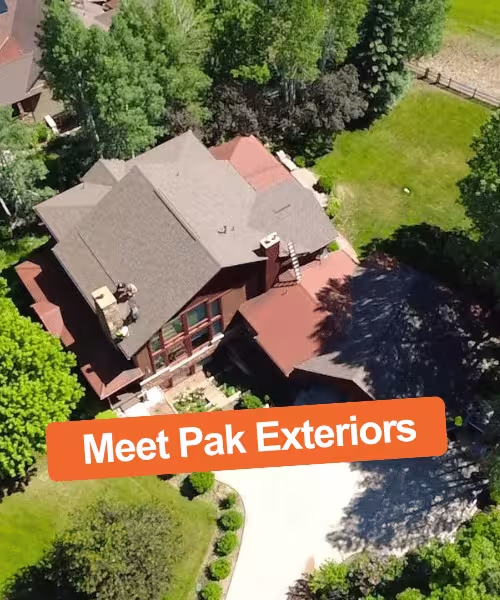
Pak Exteriors is a Colorado roofing and exteriors company that serves Denver, the Front Range, and the mountain communities. The whole company is built around radical transparency. Pricing is on the website. Real project costs are in the Our Work section. The Instant Roof Estimator gives you a real number on your roof before you ever talk to a salesperson. The Learning Center has more than 70 articles covering attic ventilation, material comparisons, warranties, home hardening, and how the insurance claim process actually works. The two owners bring complementary depth to all of it. Eric Smith has 22 years in the industry spanning contracting, distribution, and insurance adjusting. Tyler spent 13 years at one of the largest roofing distributors in North America, which gives Pak unusual depth on product knowledge and material costs.
Pak works with most major roofing manufacturers, not just one, which means they pick the product that fits your home instead of the product that fits their supplier deal. They install asphalt, synthetic composite, stone-coated steel, standing seam metal, low-slope membranes, and coatings, and they hold a Class B general contractors license across most Colorado jurisdictions for full-home exterior projects. Pak also does a lot of HOA and property management work across the Front Range and the mountains, including multi-unit and shared-asset projects that need the extra documentation and approval coordination most contractors don't want to deal with.
Pak's approach to mountain installations starts with attic ventilation as the foundation of ice dam prevention, layered with heat cable where the roof geometry makes ice dams unavoidable. Snow retention systems get designed and installed based on roof pitch, material, and the actual snow load conditions of your home, not pulled off a generic add-on list. Material selection follows the same logic. Asphalt, synthetic composite, stone-coated steel, and standing seam metal all behave differently under freeze-thaw and snow load, and the right material depends on the specific home. As of May 2026, Pak also installs ember blocking screens at all roof vent openings as standard mountain installation practice, ahead of broader enforcement of current Wildland-Urban Interface requirements.
Here's the honest tradeoff: Pak's transparency-first approach asks more of you than a hand-it-off contractor does. If you want to delegate the entire process without staying involved, Pak's approach probably isn't built for you. The model is designed for homeowners who want to understand what's happening with their roof from start to finish.
What is The Roofing Company known for?
The Roofing Company is a Granby-headquartered Colorado mountain roofing specialist that's been operating since 1976. Mountain roofing is all they do. They have around 100 employees and have completed work across the Colorado high country for nearly 50 years. The owner serves as president of the Colorado Roofing Association.
They work across the full range of steep-slope materials including asphalt shingles, metal panels, tile, shake, slate, and synthetic roofing, plus low-slope systems including EPDM, TPO, PVC, Fibertite, Hydrotech, and Dectec for both commercial and residential applications. They also offer snow removal services, ice melt solutions, custom metal fabrication, snow guards, and heat cable systems built specifically for mountain conditions.
Mountain-only craft built across nearly 50 years of high-altitude work. They've won the Colorado Roofing Association's Job of the Year multiple times on high-profile mountain projects including Vail Village Inn Plaza, the Snowmass Homestead, Vail Mountain View Condos, the Ritz Carlton Residences, the Gates at Beaver Creek, and the Arrabelle at Vail Square. Most of their employees have been with the firm for decades.
The Roofing Company is set up for mountain-specific specialty work and large, complex projects across the high country. Their pricing and scheduling reflect that. If you're shopping a straightforward asphalt reroof on a smaller mountain home, you may not be the highest priority within their project mix, which is worth asking about up front.
What is G&G Roofing known for?
G&G Roofing is a family-owned Summit County roofing contractor headquartered in Frisco, Colorado, with offices in Frisco since the 1970s and operating roots dating to 1968. They serve Summit, Eagle, Park, and Lake Counties across the broader high country, and they're BBB accredited and GAF certified.
They offer complete mountain roofing services including new installations, re-roofing, repairs, and maintenance across asphalt shingle, metal, and EPDM systems. Their mountain-specific services include heat tape installation, snow bars, snow guards, snow gems, custom sheet metal work, and roof snow removal. As a GAF-certified contractor, they install GAF System Plus warranty-qualifying roof systems.
Locally rooted Summit County craft built on five decades of high-country roofing experience. Their public language leads with roofing knowledge, materials, and customer service rather than insurance claim handling. Customer reviews verified through GuildQuality show real Summit County customers in Frisco, Breckenridge, and Silverthorne with consistent satisfaction across recent projects.
G&G is a smaller-scale Summit County operator compared to some of the larger mountain contractors. The smaller scale is part of what allows them to be responsive to local customers. Project capacity during peak summer construction season and depth of crew for large complex projects are worth asking about up front.
What questions should you ask any of these roofers, or anyone else you're considering?
The right questions reveal whether a contractor thinks about roofing the way a real roofer does or the way a claim operation does.
- How do you calculate attic ventilation, and can you walk me through the math on my home?
- What's covered under your workmanship warranty, and for how long?
- Can you show me a real itemized scope and price before I commit?
- What happens if something goes wrong six months after the job is finished?
- If an insurance claim is involved, how do you handle it, and what's my role in the process?
A real roofer should be able to answer all five questions clearly. If a contractor stumbles on the first four and only lights up on the fifth, that tells you what their core competency actually is.
See also
- Pak Exteriors Roofing Services in Summit County
- 8 Questions to Ask Any Colorado Contractor Before You Move Forward
- How to Tell If a Roofing Contractor Actually Knows What They're Doing
- What a Colorado Roof Replacement Should Look Like From Start to Finish
- Attic Ventilation 101
- Heat Cable Price Guide
- Home Hardening for Wildfire
Want a real number on your Summit County roof?
Pak Exteriors puts pricing on the website and gives you a real estimate before you ever talk to a salesperson.