

Castle Rock, Colorado
Roofing Contractors to Avoid in Castle Rock, Colorado: Red Flags Every Homeowner Should Know (2026)
TLDR
Castle Rock isn't short on roofers. It's short on easy ways to tell which ones actually match the roof to your home instead of running a claim. This article is a field guide to that: the warning signs you can see, the language to listen for, and the questions that expose a claim-first operation. No names, just patterns you can check.
The red flags this article covers, at a glance:
- →Claim-based or retail-based
- →Offering to cover your deductible
- →Post-storm door knocking
- →No pricing without a phone call
- →A pitch, not an explanation
What makes Castle Rock roofing different?
Castle Rock roofing is different from the rest of the south metro in three ways: a town building department that runs a stricter reroof code than the unincorporated Douglas County areas next door, an elevation that almost touches the mountain template line, and a housing stock that spans master-planned tract homes and large-acreage custom estates.
If your home is in Castle Rock, the permit comes from the Town of Castle Rock Building Division, not Douglas County. That distinction matters because Castle Rock's reroof rules are noticeably stricter than the county standard most Front Range contractors are used to working with. The town requires 100% tear-off on every reroof. Overlays are not permitted, period. A mid-roof inspection is required on every job, scheduled once the roof is 100% dried in with no less than five rows of covering installed and up to 50% maximum. The roof cannot be completed until that inspection passes. Ice and water barrier is required per 2018 IRC Table R905.1.2. Drip edge is required at eaves and rakes. Wind design is 115 mph, Exposure B. And the permit expires if no inspection happens within 180 days, so the project has to keep moving once it starts. A roofer who mostly works the unincorporated county side may not have all of that priced into their first proposal.
Castle Rock sits at about 6,224 feet. That elevation matters because the Colorado mountain template kicks in at 6,400 feet, where Class A fire rating becomes required by elevation. Castle Rock is roughly 175 feet below that line, so the weather drivers here are still Front Range drivers. Hail leads by a wide margin. Wind events that pull at fasteners and flashings. Freeze-thaw cycles year after year. Snowfall is moderate by Colorado standards, around 40 inches a year. Most full roof replacements end up going through an insurance claim at some point.
The housing stock is wide. Master-planned communities like The Meadows and Founders Village hold thousands of late-1990s through 2010s tract and semi-custom homes with architectural asphalt roofs. Sapphire Pointe sits up off Crowfoot Valley Road with larger semi-custom homes on bigger lots. Diamond Ridge is a small custom enclave perched above town, also off Crowfoot Valley. Bell Mountain Ranch is large-acreage custom estates just minutes from I-25. Keene Ranch is remote luxury at the base of Dawson Butte, with custom homes on 5 to 20 acres of equestrian property.
Most reroofs here land in the impact-rated Class 4 asphalt or designer architectural shingle range, both of which align well with the hail conversation. For the estate-grade acreage neighborhoods (Bell Mountain Ranch, Keene Ranch, Diamond Ridge), premium options like synthetic composite (DaVinci, Brava, Cedur, F-Wave), stone-coated steel, and standing seam metal often fit the architecture better and are worth pricing if the budget allows.
Why are there so many Castle Rock roofers to avoid?
There are so many Castle Rock roofers to avoid because fast growth and steady hail draw more claim-model crews than the market can vet.
A booming, hail-exposed town is a magnet for contractors who follow the storms. Many are organized around the insurance claim, and a good share work the area from elsewhere without knowing how the town actually does things. The result is a lot of crews competing on speed and claim handling rather than on whether they've built the right roof for your specific home. They look fine in a first meeting. The gap shows up in the details, which is where the patterns below come in.
The Front Range is one of the most active hail markets in the country. The average Colorado home gets hit with damaging hail every seven to ten years. That volume has created an industry where a significant portion of roofing revenue runs through insurance carriers rather than homeowners paying out of pocket. Over the last twenty years, an entire category of contractor has grown up around that claim volume. These companies didn't start as roofers who got good at handling claims. They started as claim operations that learned to install roofs. The business is built around the claim, not the roof.
Read the patterns below as a way to find the gap early. None is an accusation, they're the observable signals that separate a roofer built around your roof from one built around your claim.
Red Flag #1: Why does it matter whether their work comes from insurance claims or homeowners paying out of pocket?
This question forces a contractor to position themselves honestly. A retail-led contractor leads with “most of our work is direct from homeowners who chose us, and we handle insurance claims when they come up.” A claim-led contractor leads with “we work with insurance” or deflects entirely. Both kinds of contractors can install a roof. The difference is what they're built around. Listen for which one they put first when they describe their work.
Castle Rock gets worked hard after storms, so settle this first. Listen for whether the contractor leads with your roof or with the insurance company.
Red Flag #2: Why should you walk away if a contractor offers to cover your deductible?
This is illegal in Colorado, and it tells you everything you need to know about the contractor. A contractor offering to “cover your deductible” or “make your deductible disappear” is either committing insurance fraud or pricing the deductible into the project in a way that misrepresents the actual cost to the carrier. Either way, you're exposed to legal and financial risk. But the bigger signal is what this tells you about how the contractor operates more broadly. A contractor willing to commit fraud against your insurance company on the front end is a contractor who will cut whatever corner is convenient when something goes wrong on your roof six months from now. How they do anything is how they do everything. Walk away.
The deductible pitch shows up here after every hail season. It's illegal in Colorado, and it tells you how the contractor handles everything else.
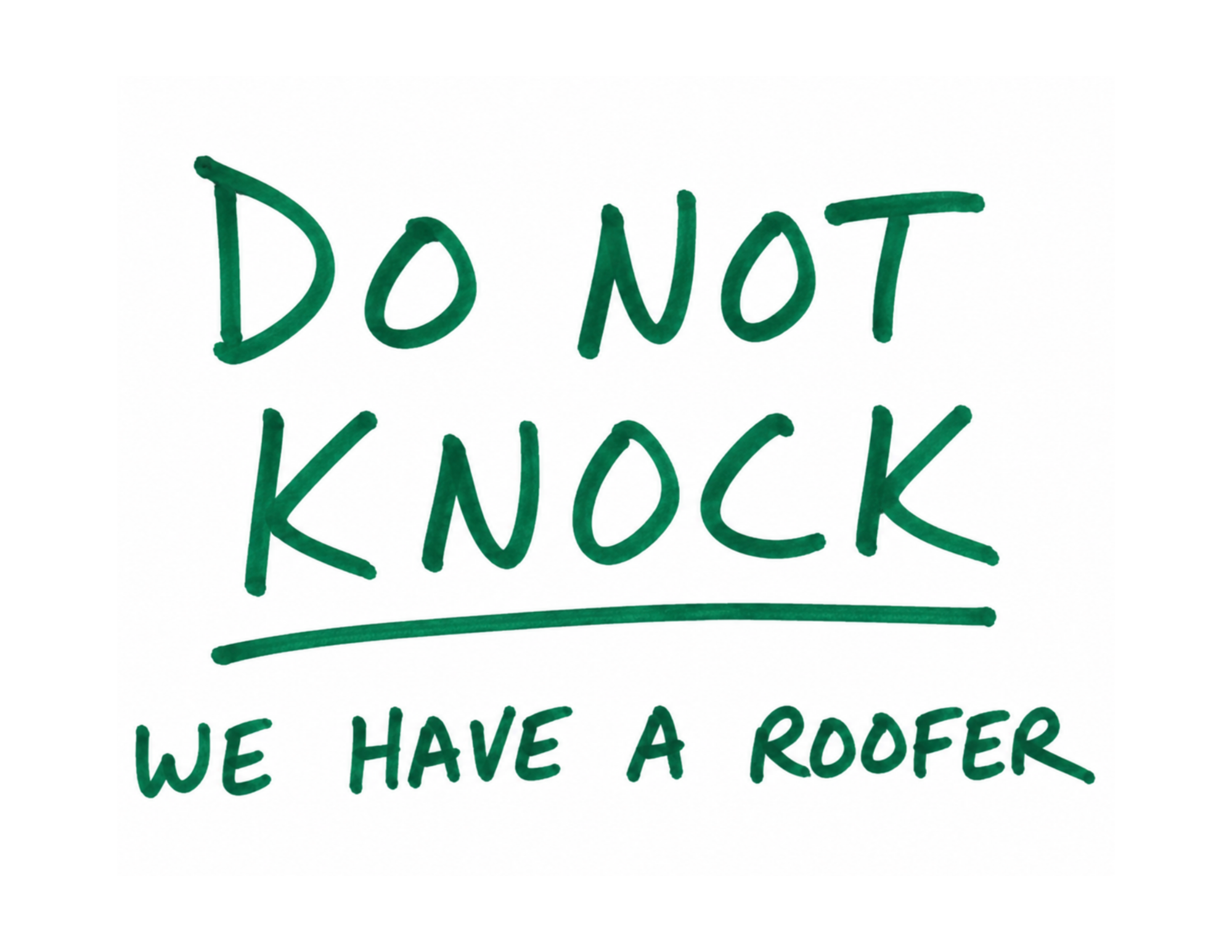
Red Flag #3: Why is door-to-door prospecting after a storm a warning sign?
Door-to-door post-storm contractors are almost always claim-driven operations with high-pressure sales playbooks. After a major hail event, contractors fan out across affected neighborhoods knocking doors. Real roofers don't typically work this way. Genuine craftsmanship-led contractors are too busy with existing customer projects and referrals to staff door-to-door teams.
See an example of what this looks like in practice: Pak's Storm Chasers After a Hailstorm article.
Castle Rock's newer subdivisions get canvassed door to door after a storm. A real roofer is too busy with referral work to staff a knocking crew.
Red Flag #4: What does it mean if a contractor won't share any pricing without a phone call?
A contractor who won't give you any pricing information online is signaling something about their business model. You should be able to establish a meaningful pricing range for a reroof on your home without calling a contractor. Real roofers make this possible in several ways: published price ranges by material category, real completed-project pricing examples with project specs, a clear pricing methodology that explains how costs are built, or an instant estimate tool that gives ballpark numbers based on home characteristics.
A typical 30 square home is enough information for any contractor to give a relative ballpark in any of these formats. Contractors who provide none of this are either running a dinner-table closing model that depends on in-home pricing reveals, or operating in a claim-driven model where the insurance carrier sets the price and there's no point in publishing pricing. Either way, you have no pricing intelligence going into the conversation. That's a deliberate choice by the contractor.
See an example of what this looks like in practice: Pak's Roof Price Guide, Siding Price Guide, Heat Cable Price Guide.
Castle Rock homes range from tract houses to large customs, so pricing should still be transparent. A contractor who won't give any range without a house call is hiding their model.
Red Flag #5: Why is a proposal that's a presentation instead of an explanation a warning sign?
A proposal walkthrough that feels like a sales pitch instead of a conversation about your roof is a warning sign. A presentation is a salesperson reading marketing materials at you. An explanation is a contractor walking you through what they're proposing, why each line item exists, what alternatives were considered, and what trade-offs each option carries. Real roofers explain. Sales operations present. The signal: does the proposal walk-through feel like a conversation about your roof, or a pitch about the company?
On a varied-stock market like this, a good contractor explains why a particular roof fits your specific home. If the proposal walk-through feels like a pitch about the company instead of a conversation about your roof, that's the tell.
What questions should you ask any contractor before you move forward?
The right questions reveal whether a contractor thinks about roofing the way a real roofer does or the way a claim operation does. Ask these:
- Does most of your work come from insurance claims, or do homeowners pay out of pocket?
- How long will the project take, and what's your crew size?
- How do you calculate attic ventilation, and can you walk me through the math on my home?
- What's covered under your workmanship warranty, and for how long?
- Can you show me a real itemized scope and price before I commit?
- What happens if something goes wrong six months after the job is finished?
- If an insurance claim is involved, how do you handle it, and what's my role in the process?
The questions a contractor cannot answer reveal the questions they don't think about. A contractor who cannot explain attic ventilation on your specific home is not doing the ventilation math on your roof. A contractor who cannot show you an itemized scope before you commit doesn't have one built yet. The question isn't whether they can answer your specific question. The question is whether the question even occurred to them before you asked. The red flags above aren't a checklist of disqualifying behaviors. They're observable patterns that reveal whether a contractor thinks about your roof the way a real roofer does, or whether they think about your roof the way a claim operation does.
A real roofer should be able to answer all of these questions clearly. A contractor who stumbles on the operational and craft questions and only lights up on the claim question tells you what their core competency actually is.
See also
Want a real number on your Castle Rock roof?
Pak Exteriors puts pricing on the website and gives you a real estimate before you ever talk to a salesperson.