



TLDR
Most contractors doing insurance work won't give you a price before you sign. That's not an accident, it's a business model. The single most important thing before you sign anything is a defined scope of work with a defined price. Without it, the contractor sets the number on the back end. Here's what to look for, what to avoid, and why your involvement in the claim matters.
Most contractors doing insurance work won't give you a price before you sign. That's not an accident. It's a business model. And it's one of the biggest risks a homeowner faces after a storm.
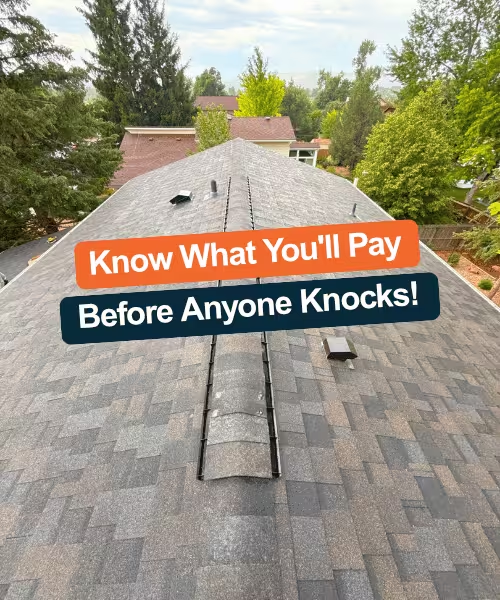
Before you put your name on anything, there's one thing that matters more than almost anything else: a defined scope of work with a defined price. This isn't a formality. It's the single thing that keeps you in control of your own claim.
What Does an Insurance Proceeds Contract Actually Mean?
Some contractors ask homeowners to sign a contract that agrees to pay "whatever insurance pays" rather than a fixed price. It's often framed as simple and convenient. You don't have to worry about the numbers; they handle everything.
Here's what that actually means. Without a defined price, the number submitted to your carrier at the end of the project is set by the contractor, not negotiated with you. You've signed an open-ended agreement with no defined ceiling and no documented basis for comparison. The homeowner is out of the loop on a decision that affects their own property.
A transparent contractor defines the scope and price before anything is signed. That documented scope gives your insurance carrier a clear basis for the claim and ensures the number they're looking at is one you've already agreed to.
How Does Good Documentation Actually Help My Claim?
Thorough damage documentation doesn't just help the contractor. It helps you. When damage is clearly photographed, quantified by slope, and tied to a specific storm event, it removes guesswork for both you and your insurance carrier. Claims with clear documentation tend to move faster and with fewer disputes.
A high-quality contractor will put together what amounts to an evidence package: a structured summary of what was found, where it was found, how it was evaluated, and what work is appropriate. That documentation isn't an argument about coverage. It's a clear record of the property's condition.
For a detailed explanation of what proper hail damage documentation looks like: What Real Hail Damage Documentation Looks Like, and Why It Matters.
What Is My Role in the Claim?
Insurance claims are contracts between homeowners and insurance companies. That means you're the primary party, not the contractor. When contractors attempt to handle the entire claim on your behalf, it can slow things down, and in some cases it crosses into territory that's legally complicated.
Your role isn't to argue with your carrier. It's to understand what damage was found, review the documentation being submitted, know your deductible and basic coverage structure, and ask questions when something doesn't make sense. That kind of involvement keeps claims moving efficiently.
More on this: Your Role in a Hail or Wind Insurance Claim, and Why Staying Involved Matters.
What Red Flags Should I Watch for Before Signing?
A few things to watch for when evaluating contractors after a storm:
- Pressure to sign before damage has been documented and explained to you
- Contracts with no defined scope or price, just a promise to do the job for whatever insurance pays
- "We'll cover your deductible" or "no out-of-pocket cost" language. This is almost never legitimate and usually means something is being hidden elsewhere in the pricing
- Guarantees about what insurance will approve. No contractor can make that guarantee. Coverage is determined by your carrier based on your policy
- Contractors who won't give you a defined price before you sign. Insurance claim expertise is real and valuable. The problem is an open-ended contract that lets the contractor set the number on the back end. Those are two different things.
A full breakdown on what to watch for: Storm Chasers After a Hailstorm: Red Flags Every Homeowner Should Know.
What Should I Look for in a Contractor on an Insurance Claim?
A contractor worth working with will show you the documentation they've prepared, explain the scope in plain language, give you a written price before asking you to sign, and be clear about what is and isn't included. They'll also tell you directly that coverage decisions are made by your carrier, not by them.
RSRA membership is one signal worth checking. The Restoration and Storm Restoration Alliance holds member contractors to defined standards on how claims are documented, communicated, and handled. A contractor who has agreed to those standards is making a commitment that goes beyond the contract you’re about to sign.
That approach might feel slower. It isn't. It's what keeps the claim from turning into a problem down the road. And it's also the approach that lets you make an informed decision about which contractor you actually want on your roof, rather than just signing with whoever showed up first.
If you want to understand what a fair price looks like before any contractor conversation, our Instant Roof Estimator gives you a realistic range based on your actual home. The Roof Price Guide breaks down what Colorado homeowners actually pay and what drives the cost.
If you're weighing whether to get multiple estimates on an insurance claim and what to actually look for: Should You Get Multiple Estimates for a Roof Insurance Claim?.
Frequently Asked Questions
What should be in a roofing contract for an insurance claim job?
A written scope listing every material being installed, all labor included, the defined price, how change orders are handled, and what the process is if additional damage is found during the project. Open-ended language like "for the amount approved by insurance" with no defined scope is a red flag.
Can a contractor guarantee my claim will be approved?
No. Coverage determinations are made by your insurance carrier based on your policy contract and the documented damage. A contractor who guarantees claim approval is making a promise they have no authority to keep.
Is it ever okay to sign before the adjuster comes out?
Yes, provided the contract is structured correctly. A contract with a defined scope of work and a defined price, contingent on your insurance carrier approving full replacement, gives you something most homeowners don't have going into an adjuster visit: a clear, documented record of what the replacement should cost and what it should include. That documentation is useful to your carrier too. It tells them exactly what's being requested before they assess the property, and it signals that there's no inflated supplement coming on the back end. What to avoid is signing an open-ended agreement with no defined scope or price that simply promises to do the job for whatever insurance pays. Those two contracts look similar on the surface. They're not.
What if my contractor says they'll handle everything so I don't have to deal with the insurance company?
Be cautious. Insurance claims are contracts between you and your carrier. Your carrier isn't obligated to communicate with your contractor, and removing yourself from the process often causes delays. A high-quality contractor supports your involvement rather than replacing it.
Where can I learn more about the insurance claims process before I sign anything?
Our complete guide: Hail and Wind Insurance Claims: A Homeowner's Guide to Doing It Right. It walks through every step from damage identification through completion.
Disclosure: The information in this article is for general educational purposes only and is not intended as legal advice, insurance advice, or public adjusting services. Insurance policies are contracts between the homeowner and the insurance carrier, and coverage determinations are made solely by the carrier based on the terms of the policy. Homeowners should consult their insurance agent, insurance carrier, or legal counsel with specific questions regarding coverage or claims. Contractors do not interpret policy language or determine coverage.