
TLDR
• DaVinci makes polymer roofing that looks like slate or wood shake, and holds up better than either in Colorado.
• It carries a Class IV hail rating and can achieve Class A fire rating, which matters in mountain and WUI communities.
• Your roof pitch determines what product you can use, what exposure is required, and how much material is needed.
• Installation is more detail-intensive than asphalt. Crew experience matters more than it does on a standard job.
• DaVinci costs more than asphalt and less than natural slate. The math makes sense for the right home and the right homeowner.
• Snow guards are not optional in most Colorado mountain applications. Plan for them upfront.
If you're looking at DaVinci synthetic roofing, you're probably weighing it against asphalt shingles or natural slate. The pitch of your roof matters here. So does the fire rating. So does who installs it. This article covers what you actually need to understand before committing, not every technical detail from the installation manual, but the things that affect your decision and your outcome.
What exactly is DaVinci, and why are people choosing it?
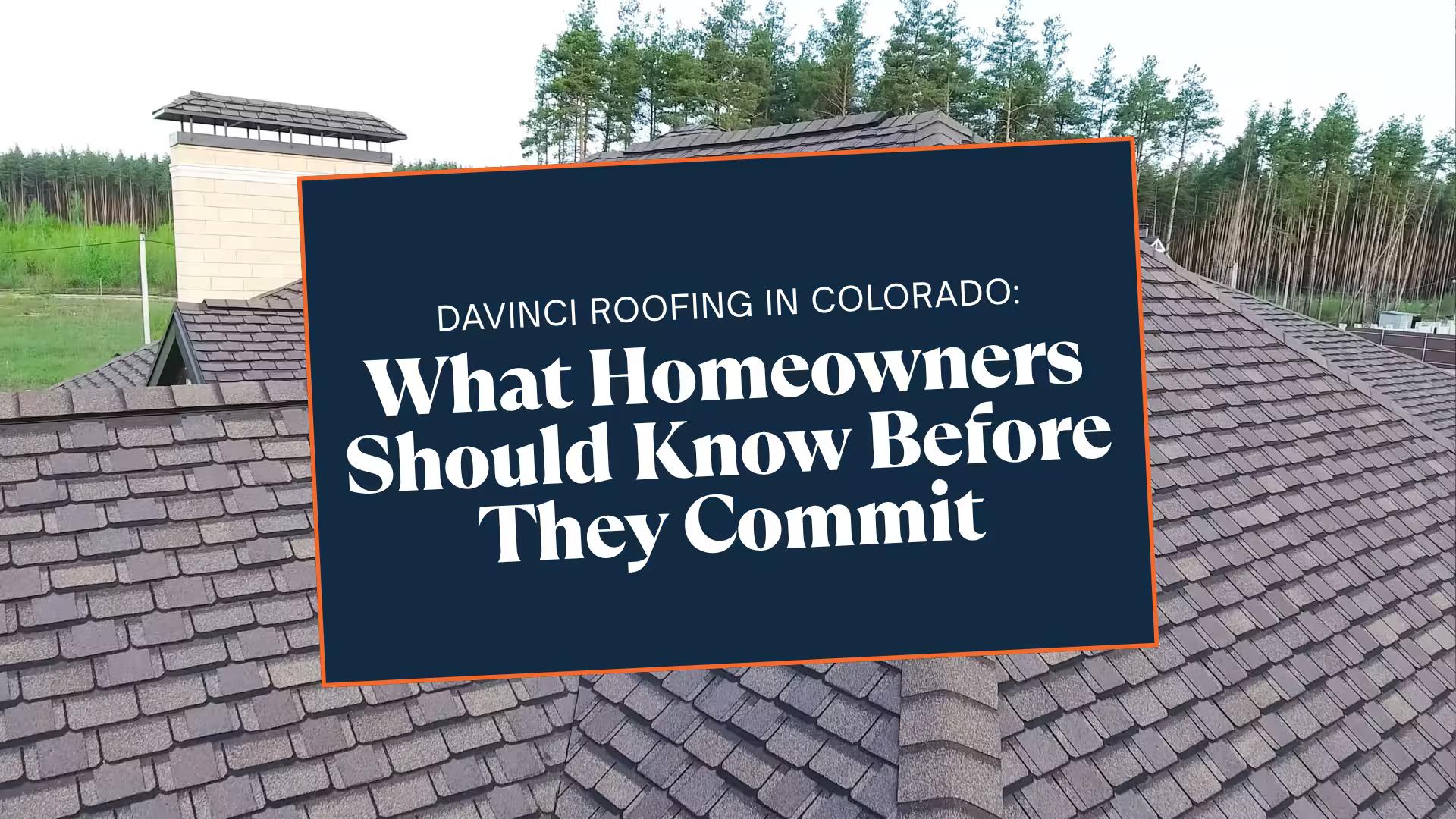
DaVinci makes polymer roofing tiles designed to replicate the look of natural slate and hand-split wood shakes. They're lighter than real slate, hold up better than real cedar, and don't rot. They carry a Class IV impact rating, which is the highest available for hail resistance. For Colorado homes, especially on the Front Range where hail is common, or in mountain and wildfire interface zones where fire resistance is required, that combination is hard to find in a single product.
The look is the other reason people choose it. If you want a shake or slate aesthetic without the maintenance headaches of the natural material, DaVinci polymer roofing is one of the better answers on the market. We install it regularly in Summit County, the Vail Valley, and on higher-end Front Range homes where asphalt isn't the right fit.
How does DaVinci compare to asphalt and natural slate in terms of cost?
DaVinci costs more than asphalt and meaningfully less than natural slate. Installed, you're typically looking at two to three times the cost of a standard asphalt shingle replacement, depending on the product line, pitch complexity, and accessories like snow guards.
Whether that math makes sense depends on how long you plan to stay in the home, what the home is worth, and what problem you're trying to solve. For a mountain home where fire resistance and hail performance are both required, DaVinci often pencils out when you factor in longevity and insurance considerations. For a standard Front Range home where asphalt performs fine and you're planning to sell in five years, it usually doesn't.
Natural slate, by comparison, is heavier, more expensive, and requires a contractor with specific installation experience that's genuinely hard to find. For most Colorado homeowners who want the slate look, a synthetic polymer alternative is a more practical path.
If you want to understand what a replacement actually costs before talking to anyone, our Roof Price Guide and Instant Estimator are good places to start. For a deeper look at what drives cost up or down on any roofing project, see What Drives Roofing Costs.
Which DaVinci product is right for my roof?
There are several lines: shake profiles (Multi-Width Shake, Single-Width Shake, Select Shake) and slate profiles (Multi-Width Slate, Single-Width Slate, Province Slate). The differences are primarily aesthetic, though pitch limitations and installation details vary between products.
The main thing to know: no DaVinci product installs below a 3:12 pitch. If your roof is that flat, this isn't the right material regardless of how much you like the look. For most Colorado residential roofs, pitch isn't a limiting factor, but it does affect how the product gets installed, which we'll cover next.
Why does roof pitch matter so much with this product?
Pitch affects something called exposure, the amount of each tile that's visible after installation. On steeper roofs you get more exposure per tile. As pitch drops, exposure gets restricted by the manufacturer. That affects how many tiles are needed, which affects material cost, and it can also change what underlayment is required to achieve a Class A fire rating. At lower pitches, the whole system spec tightens.
We've seen this go wrong in two ways when a contractor isn't paying close attention to pitch. The first is that they install at the wrong exposure for the roof's slope, which doesn't just affect material quantity, it can void the manufacturer warranty. The second is subtler: they estimate materials using a standard exposure, show up on site, realize the correct exposure requires more tile, and come up short. With asphalt that's a one-day fix. With DaVinci it's not. These are specialty products with real lead times, sometimes significant ones depending on the profile and color blend you've chosen. A roof that runs short on material can sit unfinished and exposed for weeks while you wait on an order. That's not a hypothetical. It happens when pitch doesn't get accounted for correctly at the estimating stage.
Ask your contractor what exposure they're quoting and how they confirmed it against your actual pitch. It's a simple question. A contractor who knows this product will answer it without hesitating.
Does DaVinci qualify for Class A fire rating?
Yes, but the underlayment has to be right. Class A fire rating is a system rating, not just a tile rating. It requires a specific fire-resistant underlayment installed across the entire roof deck. Standard 30-lb felt doesn't get you there.
For homes in mountain communities, wildfire interface zones, or anywhere a Class A rating is required by code or insurance, confirm with your contractor before materials are ordered that the correct underlayment is built into the quote. And as noted above, pitch affects which underlayment system is required. On lower-pitched roofs, the path to Class A may differ from what's used on a steeper roof.
What does installation actually look like, and why does crew experience matter?
More involved than asphalt. That's not a knock on the product. It's just accurate. A few things worth knowing:
Deck condition matters.
DaVinci installs over clean plywood or OSB. All previous roofing material comes off first. Any imperfection in the deck can telegraph through to the finished surface, so damaged or uneven decking needs to be addressed before installation begins.
Ice and water shield is required in Colorado.
Colorado's average January temperatures trigger the cold-climate underlayment requirement for most communities. That means self-adhered membrane from the eave edge extending two feet inside the warm wall line, and in all valleys, no exceptions.
The tiles need room to move.
Polymer expands in heat. Installers leave a gap between tiles specifically for that reason. An installer who presses tiles tight is setting up problems down the road.
Chalk lines, not guesswork.
Straight coursing requires frequent chalk lines snapped on the underlayment. If an installer is eyeballing the layout, that's worth raising.
Metal specifications matter more than they do on an asphalt job.
One of the more common places a copy-paste approach breaks down on a DaVinci install is the metalwork. Contractors who treat this like a standard asphalt job often carry over the same metal specs, and that's a mistake. DaVinci generally calls for heavier gauge metal than what's typical on an asphalt roof, and that applies everywhere metal shows up: valleys, step flashing, eave flashing.
Step flashing is a good example. DaVinci uses a larger step flashing piece than standard asphalt installs require. The size is designed to match the exposure of the tile. If the step flashing is undersized, water can get behind it. Surprisingly, this gets missed on DaVinci installs more often than it should. It's one of the details that separates a contractor who has done this before from one who is treating it like any other roof.
Valleys deserve an intentional plan, not a default.
Valleys are a real consideration with DaVinci, and there's no single right answer, but there should always be a deliberate one. The gauge of the valley metal matters. So does how the valley is configured. There are several approaches: single diverter, double diverter, open valley, closed valley. Each one does something different.
Sometimes the configuration is about improving water diversion on a complex roof. Sometimes it's designed around a heat cable system, creating channels the cables run inside of so they're protected and not visible from the ground. Sometimes it's purely aesthetic, making sure the cut edges of the DaVinci tiles aren't exposed at the valley line.
What matters is that your contractor has a reason for what they're doing and can explain it. If the answer is 'that's just how we do valleys,' that's worth probing. The valley approach should be specific to your roof, not a default carried over from the last job.
Specialty installs take longer than asphalt.
A standard home that an asphalt crew might finish in a day will take longer with a synthetic polymer product. That's expected. If someone is quoting you a fast DaVinci install at asphalt labor pricing, slow down.
Do I need snow guards?
If you're in Summit County, the Vail Valley, Aspen, Grand County, or anywhere else that sees real accumulation, the answer is almost always yes. Polymer roofing sheds snow efficiently, which sounds like a feature until a wall of snow drops onto your deck, landscaping, or a person walking by.
Snow guards should be spec'd upfront and installed during the roofing project. Retrofitting them later is more expensive and more disruptive. Bring it up before the contract is signed. A contractor who works regularly in mountain communities should be raising this without being asked.
What should I ask a contractor before they bid this?
A few questions that tell you a lot quickly:
Ask what exposure they're quoting and how they confirmed it matches your pitch. If they hesitate, that's informative.
Ask which underlayment system they're using and how Class A fire rating is achieved. A contractor who has installed this product before answers this without looking anything up.
Ask what metal specs they're using, gauge of valley metal, step flashing sizing. On a standard asphalt job this is rarely a conversation worth having. On a DaVinci install it is. The step flashing in particular is larger than what's used on asphalt, sized to match the tile exposure. A contractor who knows this product knows that without being told.
Ask which valley configuration they're planning and why. There are several legitimate approaches, but the answer should be specific to your roof, not a default. If heat cables are part of the picture, ask whether the valley design accounts for them.
Ask whether snow guards are included. For mountain homes, this conversation should happen without you having to prompt it.
Ask how many DaVinci installs they've completed. Not to disqualify someone newer to the product, but to calibrate how closely you should be paying attention during the project.
The bottom line
DaVinci synthetic roofing is a well-built product that performs well in Colorado's climate. It's also a more significant investment than asphalt, and the installation quality determines whether that investment holds up over time. The tile itself can last decades. What determines how it performs is largely what happens during the install, the underlayment system, the exposure calculation, the valley detail, the nailing, the snow retention plan.
Choose the product carefully. Put equal thought into who's doing the work.
Ready to start understanding numbers? Use our Instant Estimator to get a ballpark before anyone comes out.
Frequently Asked Questions
What is the minimum roof pitch for DaVinci?
3:12 across all product lines. Below that, DaVinci does not recommend installation.
How heavy is DaVinci compared to natural slate?
Significantly lighter. Installed DaVinci typically runs 250 to 350 lbs per square depending on product and exposure. Natural slate runs 700 to 1,500 lbs per square. That difference matters for older structures and existing framing.
Does getting the exposure wrong void the warranty?
Yes. Installing at an exposure that isn't approved for your roof's pitch is an installation error that can void the manufacturer warranty. This is one of the more common mistakes made by contractors unfamiliar with the product.
How long does DaVinci take to deliver if you run short on material?
Lead times vary by product line and color blend. Some profiles ship relatively quickly. Others, especially less common profiles or custom blends, can take several weeks. Running short mid-install is a situation you want to avoid entirely, which is why accurate estimating at the right exposure matters before the project starts.
Can solar panels be added to a DaVinci roof?
Yes. DaVinci is compatible with solar installations. The solar system manufacturer should be involved in planning to ensure the mounting approach doesn't compromise the roof system.
Are snow guards required by code?
Not universally, but they're strongly recommended in any area with meaningful snow accumulation. The decision ultimately rests with the homeowner, but for mountain Colorado homes, leaving them out is a risk most experienced contractors won't recommend.
Does DaVinci come in multiple colors?
Yes, multiple blends per product line. Bundles arrive pre-collated with color and width variation already mixed in, which ensures the aesthetic looks natural and consistent across the finished roof rather than uniform or patchy.