
For real estate agents, insurance agents and property managers

Roof and insurance guide for Colorado agents

Roofs come up at inspections, renewals and board meetings all over Colorado. We wrote down our answers to the roof questions agents and managers ask us, and linked each law and code to its source.

By Eric Smith, co-founder, Pak ExteriorsLast updated

Free tool

Create your roof report for any Colorado address

Type the address and what you know about the roof. You get a page to hand to a client or keep in the file, with your name on it.

Report for

Set from the address. Change it if the home sits on the other side of the line.

Add what you know about the roof (optional)
Roof material, if you know it
Roof age, if you know it
Class 4 impact-rated?

Free. The report is built in your browser and we don’t save it. Your email is only needed for Pak Roof Notes.

01 / 08Statewide

How old can a roof be before carriers refuse or limit coverage in Colorado?

Short answer

There’s no single age. Colorado law doesn’t set a roof age limit, so each carrier writes its own rule and files it with the Division of Insurance, where it stays confidential. What the law does set is notice: before a carrier cancels or refuses to renew a homeowner’s policy, it has to mail 60 days’ notice that states the specific reason.

What the law does set

On a new policy
30 business daysfor the carrier to decide on a full policy and finish any underwriting inspection
Before a cancellation or nonrenewal
60 daysof mailed notice, with the specific reasons10 days when the reason is nonpayment

Source: C.R.S. § 10-4-110.7

The details

Where roof age shows up

It can decide whether a carrier writes a new policy, whether the roof is paid at replacement cost or actual cash value, and what the premium is.

The Division of Insurance’s standard homeowners summary of coverage form lists “roof age or type” as a factor that can bring a discount or a surcharge. It also lists roof age as a possible reason for cancellation or nonrenewal.

Why you can’t look the number up

Carriers file their underwriting methods with the insurance commissioner, and those filings aren’t public record (C.R.S. § 10-4-110.7(4)). Ask the client’s insurance agent for the carrier’s current roof rule early in the deal.

Notice rules

A carrier must mail at least 60 days’ notice, with the specific reasons, before it cancels or nonrenews. For nonpayment the notice period is 10 days (C.R.S. § 10-4-110.7(3)). HB 23-1174 raised the notice period from 30 to 60 days.

New policies can start out conditional

A carrier can issue conditional coverage while it looks at a property. It then has 30 business days from the start of that coverage to decide on a full policy, and any underwriting inspection has to happen inside that window. The window can run longer if the carrier has a reasonable basis to investigate further or needs repairs made (C.R.S. § 10-4-110.7(5)). On a sale, that means a carrier can still be looking at the roof after closing.

The contract deadline

The Colorado Real Estate Commission’s residential purchase contract gives the buyer a Property Insurance Termination Deadline, tied to the availability, terms and premium of insurance on the property. A quote that spells out the roof terms gives the buyer something solid to decide on before that date.

When no carrier will write it

The Colorado FAIR Plan is the insurer of last resort, created by HB 23-1288. Applying takes three declinations from standard carriers and a licensed agent.

Mountain homes face extra carrier questions. Those are in section 5.

02 / 08Statewide

What should clients know about actual cash value vs replacement cost on a roof?

Short answer

Replacement cost pays to repair or replace the roof without subtracting depreciation. Actual cash value subtracts depreciation first, so an older roof gets a smaller check. A policy can cover the house at replacement cost and still pay the roof a different way, so read the endorsements as well as the declarations page.

Same roof, same storm, two policies

A $15,000 roof claim with a $1,000 deductible

Paid at

Replacement cost

Roof claim
$15,000
Depreciation
$0
Deductible
− $1,000

The owner receives

$14,000

$14,000 of the $15,000

Paid at

Actual cash value

Roof claim
$15,000
Depreciation
− $10,000
Deductible
− $1,000

The owner receives

$4,000

$4,000 of the $15,000

The definitions and the example come from the National Association of Insurance Commissioners (NAIC).

The details

Replacement cost and actual cash value, side by side

Replacement cost compared with actual cash value on a roof
TopicReplacement costActual cash value
What it paysCost to repair or replace, with no deduction for depreciationDepreciated cost to repair or replace
Effect of roof ageThe first check can be lower, and the held-back amount is paid under the policy’s termsThe older the roof, the bigger the deduction
NAIC example: $15,000 roof claim, $1,000 deductibleOwner receives $14,000Owner receives $4,000 (after $10,000 depreciation)
Where to lookDeclarations page and endorsementsDeclarations page, endorsements, and any roof-only payment schedule

Four questions for the client’s agent

  1. Is the roof paid at replacement cost or actual cash value?
  2. Is there a roof-only endorsement or payment schedule?
  3. Is there a separate roof or wind/hail deductible, and is it a percentage?
  4. How long does the owner have to finish the work and collect the held-back depreciation?

Roof-only terms

Some policies pay the roof at actual cash value, or on a schedule based on roof age, even when the house is at replacement cost. State regulators track these roof terms as their own category in the NAIC homeowners data call. Look for the word “roof” in the list of endorsements.

Held-back depreciation

On a replacement cost claim, the difference between replacement cost and actual cash value is what Colorado law calls recoverable depreciation (C.R.S. § 10-4-110.8(3)(h)). The policy sets when and how that amount is paid, often after the work is finished.

What Colorado requires carriers to offer

Before issuing or renewing a replacement cost policy, carriers must offer extended replacement cost of at least 50% of the dwelling limit, plus law and ordinance coverage of at least 20%. The declarations page has to say in bold whether the owner bought or declined them (C.R.S. § 10-4-110.8(6)(a)).

For policies issued or renewed since January 1, 2025, the carrier has to provide a reconstruction cost estimate and explain how it was calculated. Roofing materials and roof type are among the factors the law lists (§ 10-4-110.8(8) and (9.5)). An owner can get a copy of the policy and declarations page within three business days of asking (§ 10-4-110.8(10)).

03 / 08Statewide

What does a roof inspection or certification cover for a home sale, and how fast is it?

Short answer

A roof inspection before listing, or during the buyer’s inspection period, records what’s on the house: the material, its condition, any damage, and anything a carrier is likely to ask about. Our written roof report spells out any repairs the roof needs and whether it qualifies for a roof certification, which typically covers 5 years. We can usually inspect within 72 hours of the request, and the written report generally follows within a week. The inspection and the certification are free.

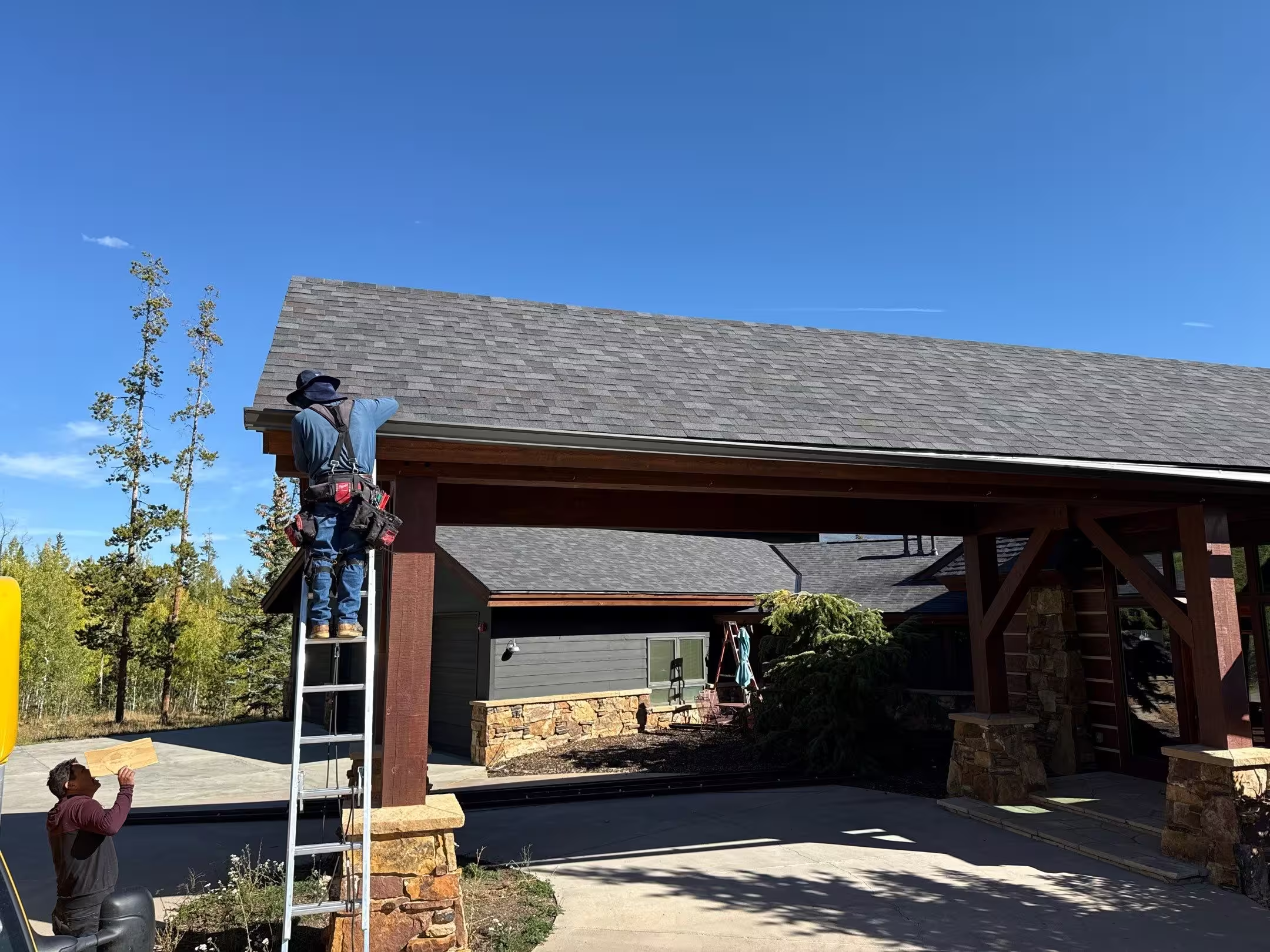
A Pak Exteriors inspector on a ladder at the eave of a shingle roof
We video the roof
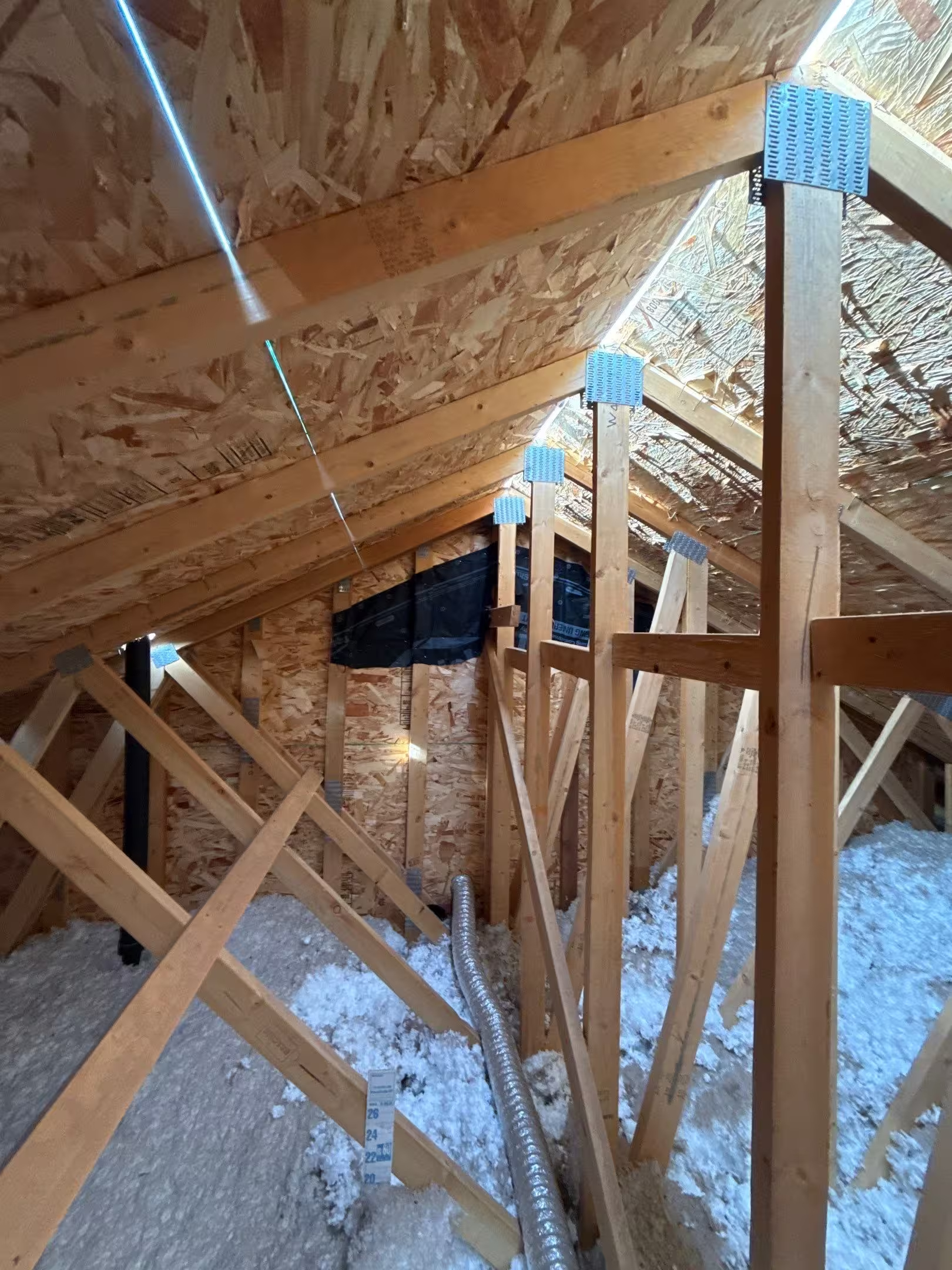
Roof framing seen from inside an attic
and check the attic

The owner doesn’t have to be home

The details

What a Pak inspection covers

We video the roof and check the attic, and the owner doesn’t have to be home. The inspection is free.

  • The roofing material and its approximate age
  • How many layers are on the house
  • Any damage
  • Flashing and roof penetrations
  • Attic ventilation and signs of leaks
  • The overall health of the roof system

While we’re on the roof, we record a short video of everything worth pointing out. If there’s damage, we show it and explain what we’re looking at. If the roof is just getting old, we point out the weak spots and give our honest estimate of how much life it has left.

The written report follows the video, with photos, descriptions and explanations of what we found.

Roof certification

Our written roof report spells out any repairs the roof needs and whether it qualifies for a roof certification. When a roof qualifies, the certification typically covers 5 years, and there’s no charge for it.

If the roof is in good shape, we can usually have a written certification to you within a few business days. If repairs are needed first, the timeline depends on what the roof needs. We walk the owner through the repairs and give a realistic timeline before any work starts.

Turnaround

We can usually get out to inspect the roof within 72 hours of the request. The written report generally follows within a week, though it can take longer depending on the roof system and the situation.

Roof wording for the listing

When Pak has replaced, certified or inspected the roof, ask us for wording you can put in the MLS listing. It names the work and the date, so buyers and their carriers know where to get the records. It reads like this:

  • Pak replaced the roof

    “[Roof type] roof installed [month/year] by Pak Exteriors, permitted and passed final inspection. [Warranty type] warranty, transferable to the buyer [with registration/fee details]. Records available from Pak Exteriors at (303) 880-4423.”

  • Pak inspected the roof and issued a 5-year certification

    “Roof inspected by Pak Exteriors on [date] and certified for 5 years, through [date]. [Repairs completed before certification, if any.] Certification details available from Pak Exteriors at (303) 880-4423.”

  • Pak inspected the roof, with no certification

    “Roof inspected by Pak Exteriors on [date]. Approximately [age] years old, [roof type]. Inspection report available on request.”

For a mountain property, the number is (970) 780-4423.

When the carrier wants paperwork

Install records, permits, product labels and manufacturer letters show an underwriter what the roof is rated. When those are missing, an inspection with photos and a written summary of the roof assembly usually rebuilds the record.

Timing in a Colorado deal

The Commission’s residential contract sets a deadline for the seller to deliver the Seller’s Property Disclosure, inspection deadlines for the buyer, and a separate Property Insurance Termination Deadline. A roof inspection before listing puts the facts in front of everyone before those dates start running.

  1. Before listing

    • A roof inspection puts the facts in front of everyone before any deadline starts running.
  2. Under contract

    • Seller’s Property Disclosure deadline
    • The buyer’s inspection deadlines
    • Property Insurance Termination Deadline

    Dates are set in the contract.

  3. After closing

    • A new policy can still be conditional for up to 30 business days while the carrier inspects.

After closing

A new policy can be conditional for up to 30 business days while the carrier inspects (C.R.S. § 10-4-110.7(5)), so a roof report in the file helps there too.

04 / 08Front Range

Front Range: What do Class 4 impact-resistant roofs mean for hail claims and premiums?

Short answer

A Class 4 roof covering passed the top level of a standard impact test: a 2-inch steel ball dropped twice on the same spot without cracking the back of the product (UL 2218). Colorado law doesn’t set a required premium discount, so each carrier decides what credit it gives, if any. Under a 2026 state law, carriers will start reporting the discounts they give homes with resilient roofs, no sooner than 2027.

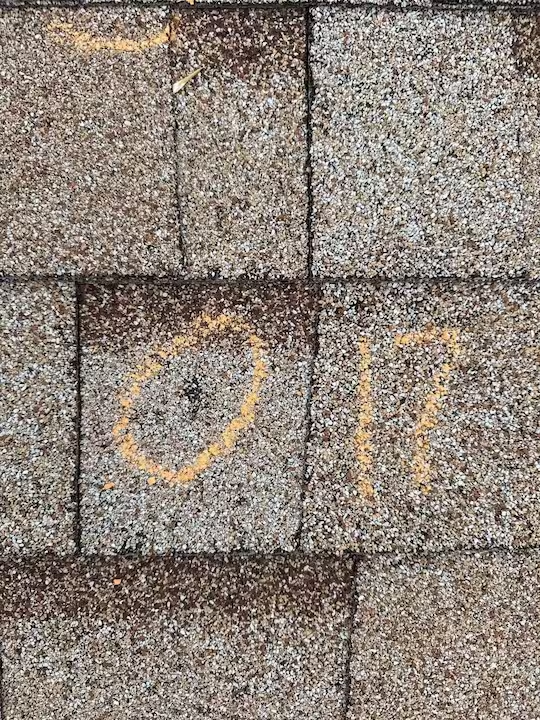
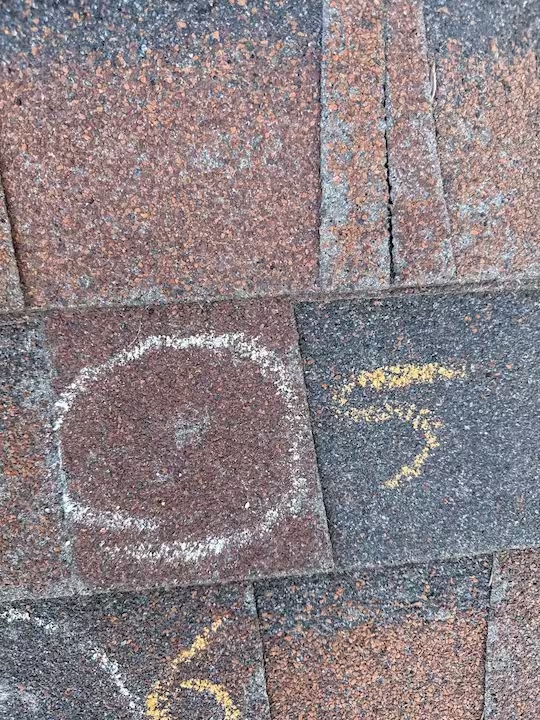
Hail hits circled in orange chalk on an asphalt shingle
Hail hits, circled and numbered

The Class 4 test

The Class 4 impact testA 2-inch steel ball is dropped twice on the same spot of a roof covering. To pass, the back of the product must not crack.2 in.Steel ballUL 2218×2samespotNo crack on the backof the product

The details

Two tests, same top class

UL 2218 drops steel balls on flexible products like asphalt shingles and metal panels. Class 4 is the 2-inch ball. FM 4473 fires ice balls at rigid products such as tile, and its Class 4 is also a 2-inch ball (IBHS).

UL 2218Steel ball

Class 4 = 2-inch ball

Dropped on flexible products like asphalt shingles and metal panels

FM 4473Ice ball

Class 4 = 2-inch ball

Fired at rigid products such as tile

Discounts are carrier by carrier

Ask the client’s agent whether the carrier credits a Class 4 roof and what proof it wants on file.

New in 2026: Strengthen Colorado Homes (SB 26-155)

New in 2026

Strengthen Colorado Homes

SB 26-155

  1. June 2026Signed
  2. August 12, 2026In effect
  3. 2027The carrier fee starts, and discount reporting can start

Signed in June 2026 and in effect since August 12, 2026, this law:

  • creates a grant program in the Division of Insurance to retrofit homes against hail and wind
  • has its board give priority to primary residences, and also weigh applicant income, roof age and home size
  • has the board set the standards for which roof systems qualify
  • funds the grants with a fee on homeowners carriers starting in 2027. The fee is 0.5% of the prior year’s premiums, and carriers can’t pass it on to policyholders.
  • bars contractors paid through the grants from waiving deductibles
  • has carriers file data on homes with resilient roofs, the discount applied, and claims with and without those roofs, starting no sooner than January 1, 2027

Wind/hail deductibles

Many Colorado policies set a separate wind/hail deductible as a percentage of coverage, such as 1%, 2% or 5% (Division of Insurance). On a home insured for $500,000, a 2% deductible is $10,000. If the damage comes in under the deductible, the carrier pays nothing.

Repeat hail claims

The Division says no Colorado law addresses nonrenewal after a hailstorm, and that a carrier may consider nonrenewing after multiple losses, hail included (Division of Insurance hail FAQ).

Class 3 vs Class 4 on price

On a 3,000 sq ft Front Range roof, our published installed price for a Class 3 asphalt shingle roof is $18,450 to $23,925. For Class 4 it is $19,845 to $24,255.

Every material is in our Roof Price Guide.

05 / 08Mountains

Mountains: What do wildfire codes, Class A roofs, ice dams and snow load mean for coverage?

Short answer

Mountain carriers look closely at a roof’s fire rating, its age and the paperwork that proves both. Colorado’s wildfire code requires a Class A roof on the buildings it covers, and replacing 25% or more of an existing roof triggers the full requirement. Ice barrier at the eaves and the design snow load come from the building code the county or town has adopted.

What “Class A” is a rating of

The whole assembly, as tested together

A Class A roof assemblyThree layers pulled apart: the roof covering on top, the underlayment or fire barrier in the middle, and the roof deck at the bottom. The Class A rating belongs to the layers as tested together.Roof coveringUnderlayment or fire barriersome shingles need a specific oneRoof deck

Tested under ASTM E108 or UL 790. The rating belongs to the covering plus the layers under it.

The details

The wildfire code

The Wildfire Resiliency Code Board, created by SB 23-166, adopted the Colorado Wildfire Resiliency Code on July 1, 2025 (8 CCR 1507-39). Counties and towns with land in the wildland-urban interface had nine months to adopt a code that meets or exceeds it (SB 25-142). Local amendments and hazard maps differ, and some towns pull their own permits, so check with the department that will issue the permit.

Class A

Class A is the top fire rating under ASTM E108 or UL 790, and the code accepts a listed Class A roof assembly (Colorado Wildfire Resiliency Code, Section 403.2). The rating belongs to the covering plus the layers under it, as tested. Some shingles only reach Class A over a specific underlayment or fire barrier, so the install records matter as much as the product name.

The 25% rule

When 25% or more of an existing roof covering is replaced or repaired, the whole roof covering has to meet the new-construction roof rules. An existing roof that’s already Class A and compliant is exempt (Section 101.6). Local versions can word the threshold differently, so confirm it with the building department.

Mountain wildfire rules, in order

Mountain wildfire rules, in order
  1. SB 23-166 creates the Wildfire Resiliency Code Board. Source
  2. SB 25-142 gives counties and towns in the wildland-urban interface nine months to adopt the code. Source
  3. The board adopts the Colorado Wildfire Resiliency Code (8 CCR 1507-39). Source
  4. HB 25-1182 takes effect: wildfire risk scores, appeals and mitigation discounts. Source
  5. Wildfire score notices start going out with applications and renewals. Source

Law and ordinance coverage

When a code forces an upgrade during a covered repair, law and ordinance coverage is the part of the policy meant for that extra cost. Colorado carriers have to offer at least 20% of the dwelling limit (C.R.S. § 10-4-110.8(6)(a)). It’s worth checking on any mountain policy.

Wildfire risk scores

Under HB 25-1182, in effect since July 1, 2026:

  • carriers that use a wildfire risk model or score must tell policyholders their score every year and how to appeal it
  • carriers must post on their websites the premium savings they give for mitigation
  • carriers whose models don’t account for mitigation must give discounts to owners who show mitigation work
  • per the Division of Insurance, the notices go out with applications and renewals starting October 1, 2026

Ask the carrier which roof upgrades it credits.

Ice dams

Where a jurisdiction has a history of ice forming along the eaves, the International Residential Code calls for an ice barrier. It runs from the lowest roof edge to at least 24 inches inside the exterior wall line. The barrier is either two layers of underlayment cemented together or a self-adhering polymer-modified bitumen sheet (IRC R905.1.2). Counties and towns adopt different code editions and amendments, so the local version controls.

Our ice dam prevention page covers ventilation and heat cable.

Ice barrier at the eaveSide view of a roof edge. The ice barrier runs along the roof deck from the lowest roof edge to a point at least 24 inches inside the exterior wall line.Exterior wall lineOutsideInside24 in. minimumLowest roof edgeIce barrierRoof deck
Not to scale. The local code version controls.

Snow load

Each building department sets its design snow load, and it can differ from one town to the next. Ask for the number before choosing a heavier roof material.

Keep the paperwork

That means the underlayment spec, the install records and the manufacturer letter. We hand every mountain client a written assembly record at closeout.

MountainsFree with Pak Roof Notes

The Mountain Roof Insurability Report

Nine pages for people who advise and manage property in Eagle, Summit, Pitkin and Grand counties. Written so any chapter can be handed to a client.

  • What carriers actually require of a mountain roof, and the Class A misunderstanding that costs people coverage
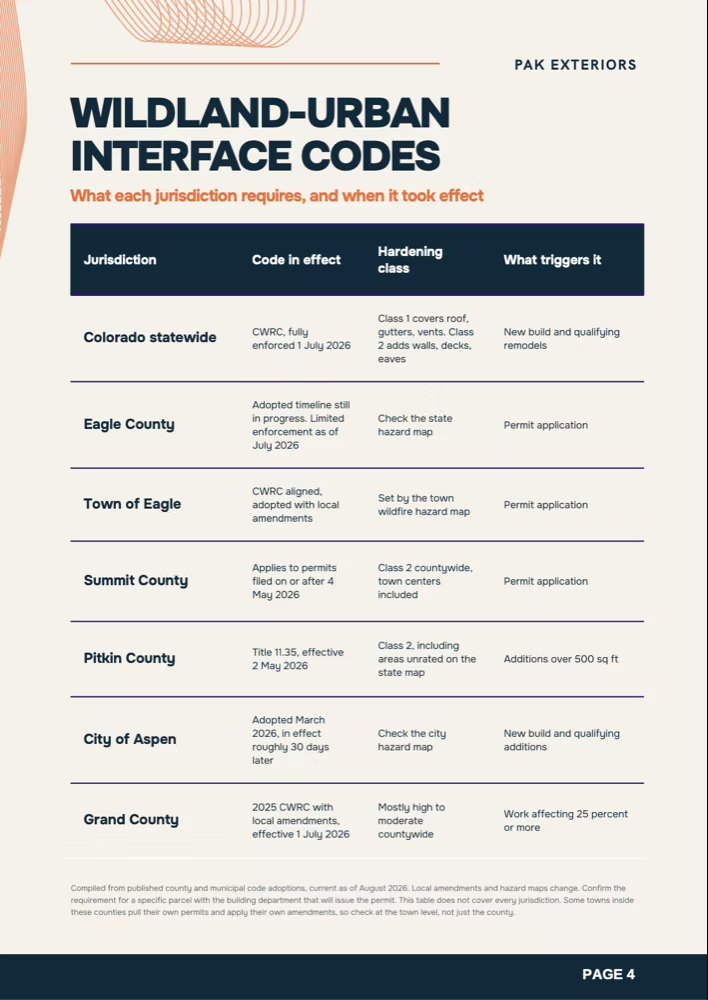
  • Wildland-urban interface code requirements by jurisdiction, with the dates each took effect
  • What the code requires at vent openings, and why it is the next Class A problem
  • What a mountain roof replacement costs per square foot, by material
  • What to do when a nonrenewal letter arrives
Sign up to get the report

It comes with Pak Roof Notes, one roof tip every Monday.

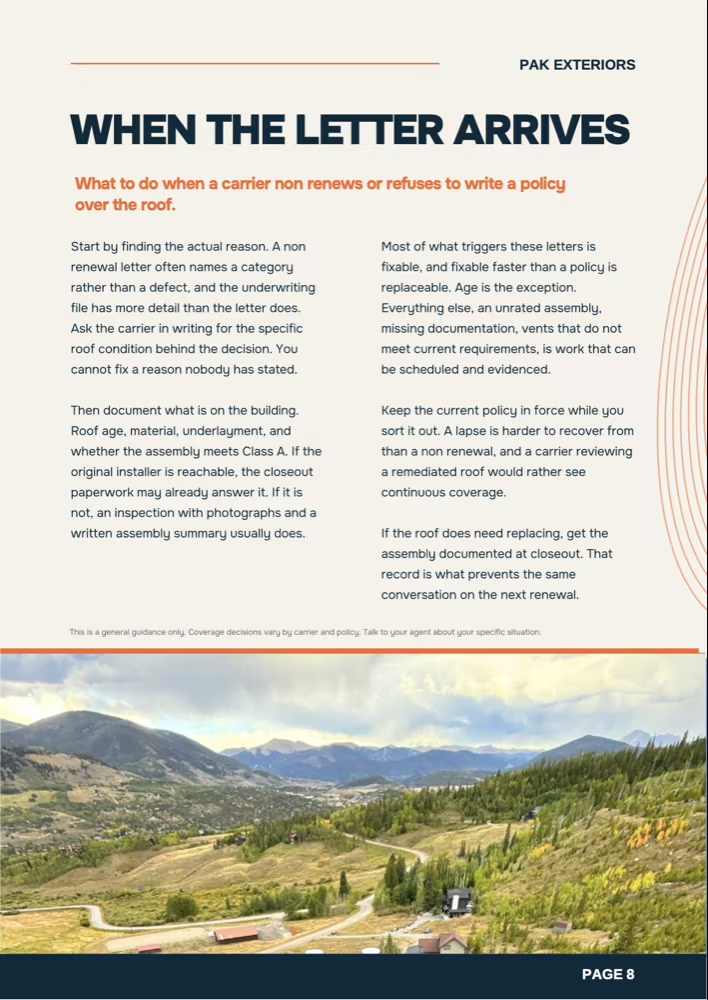
Report page: When the letter arrives, what to do when a carrier nonrenews or refuses to write a policy over the roofCover of the Mountain Roof Insurability Report, 2026 edition, by Pak ExteriorsReport page: wildland-urban interface codes, what each jurisdiction requires and when it took effect, for Colorado statewide, Eagle County, the Town of Eagle, Summit County, Pitkin County, the City of Aspen and Grand County
06 / 08Statewide

How does an insurance roof claim work with a roofer in Colorado, and what are the deductible rules?

Short answer

The homeowner files the claim and pays the deductible, and Colorado law bars a roofer from paying, waiving or rebating any part of it (C.R.S. § 6-22-105). A roofer with a signed contract can discuss the scope of repairs with the adjuster for the owner, but can’t act as a public adjuster. Before work starts, the owner gets a written contract with the terms state law requires.

What the contract must includeC.R.S. § 6-22-103
  • Scope and materials
  • Approximate dates
  • Approximate cost, based on the damage known at signing
  • The roofer’s contact details, including a physical address
  • The roofer’s liability and surety insurer, if any
  • The cancellation and deposit refund policy
  • A statement of the owner’s right to rescind
  • A statement that the roofer can’t pay, waive or rebate the deductible

In bold: the roofer holds the owner’s payments in trust until materials are delivered to the site or most of the work is done.

The details

How a claim usually runs

  1. Step 1

    Document and protect

    Take photos before any repairs, and cover openings so the damage doesn’t spread (Division of Insurance).

  2. Step 2

    Report the claim

    Check the policy for its deadline to report a loss.

  3. Step 3

    Adjuster inspection

    A roofer under contract can meet the adjuster and talk scope (C.R.S. § 6-22-105(3)).

  4. Step 4

    Estimate and added damage

    If more damage turns up once work starts, tell the carrier before the work continues (Division of Insurance).

  5. Step 5

    Payment

    On a replacement cost policy, the held-back depreciation is paid under the policy’s terms (see section 2).

  6. Step 6

    Denial

    Ask for a letter that names the policy language behind the decision (Division of Insurance).

72 hours to cancel after a denial

The owner can cancel within 72 hours after the carrier’s written notice that the claim is denied in whole or in part. The roofer has 10 days to refund, and can keep payment only for work actually done (C.R.S. § 6-22-104).

Deductible violations

If a roofer advertises or promises to cover a deductible, the carrier doesn’t have to consider that roofer’s estimate, and the owner or the carrier can sue (C.R.S. § 6-22-105).

Before signing

The Division suggests confirming a roofer’s license number with the city or county building department that issued it. It also warns that an assignment of benefits clause can leave the owner paying for repairs the carrier doesn’t cover (Division of Insurance).

How we help

Eric holds Xactimate Level 1 and Level 2 certifications, so we understand how insurance estimates are written and where they tend to differ from a contractor’s real costs.

On a claim, we document every bit of damage we find in a detailed photo report, including items outside our scope, so the carrier sees the full picture. We give the owner a written roof and gutter scope with real numbers, and we like to be there when the adjuster inspects.

If the carrier’s estimate comes in lower than the actual cost of the work, our claims team shows the owner exactly where the difference is and why.

More on our insurance claim support page.

07 / 08Statewide

What does a new roof cost in Colorado?

Short answer

Size, pitch, material, access and region set the price, and mountain jobs cost more than Front Range jobs on the same material. On a 3,000 sq ft roof, our published price for a Class 4 asphalt shingle roof is $19,845 to $24,255 on the Front Range and $24,737 to $30,235 in the mountains. For a number on a specific address, our Instant Roof Estimator measures the roof from satellite imagery and prices it at our published rates.

What moves the number

What moves the price of a roofA house with five numbered spots: a steep pitch, extra layers to tear off, soft decking under old shingles, access, and in the mountains elevation, snow load and a shorter working season.12345
  1. a steep pitch
  2. extra layers to tear off
  3. soft decking under old shingles
  4. access
  5. in the mountains: elevation, snow load and a shorter working season

The details

Prices by material and region

Roofers price by the square, which is 100 sq ft of roof.

Installed roof cost by material and region
MaterialFront RangeMountains
Class 3 asphalt shingle$18,450 to $23,925$23,890 to $29,199
Class 4 asphalt shingle$19,845 to $24,255$24,737 to $30,235
Standing seam metal$48,600 to $59,400$68,715 to $83,985
Synthetic shake or slate$62,100 to $75,900$72,360 to $97,350

Installed price for a 3,000 sq ft roof, from our Roof Price Guide. Not a quote for a specific roof.

On an insurance job

The carrier’s estimate sets what it pays. The owner pays the deductible, plus any upgrade the policy doesn’t cover.

08 / 08Statewide

How do I refer a client to Pak Exteriors?

Short answer

Call the line for the property’s market: Front Range (303) 880-4423, Mountains (970) 780-4423. You can also send your client to our booking page to pick an inspection time. Inspections are free, and the owner doesn’t have to be home.

The details

What to tell us

Tell us you’re the agent or manager, and which deadline is coming up (inspection, insurance or closing).

Once we have the client’s permission, we send you the inspection report and the video walkthrough as soon as they’re finalized.

Property managers and HOA boards

We inspect across multiple buildings for HOA boards and property managers, and it’s a big part of how we work with them. Tell us how many buildings when you call.

A specific mountain parcel?

The answer usually depends on the jurisdiction issuing the permit, and we’re happy to look at it with you.

Pak Roof Notes

One roof tip every Monday

Pak Roof Notes is a short weekly email for Colorado agents and property managers: one roof tip, written in plain language, that you can pass along to a client.

Tips cover things like

  • What an adjuster looks at on a roof
  • What a carrier asks for on a mountain home
  • What to check before listing a house with an older roof
Eric SmithTyler Music

Eric and Tyler, Pak Exteriors

I'm a
My market

One email a week. Unsubscribe any time. Privacy policy

Eric Smith

About the author

Eric Smith, co-founder, Pak Exteriors

Eric Smith grew up in Colorado and is co-owner of Pak Exteriors. He has worked across insurance claims, restoration and roofing distribution. That background shapes how Pak approaches pricing transparency, scope documentation and the insurance process.

About Pak Exteriors
Eric SmithTyler Music

Pak Roof Notes

One short roof tip every Monday

Written for the people who sell, insure and manage Colorado homes. Subscribers also get our Mountain Roof Insurability Report.

By signing up you’ll get Pak Roof Notes, one roof tip every Monday. Unsubscribe any time. Privacy policy

Eric and Tyler, Pak Exteriors