


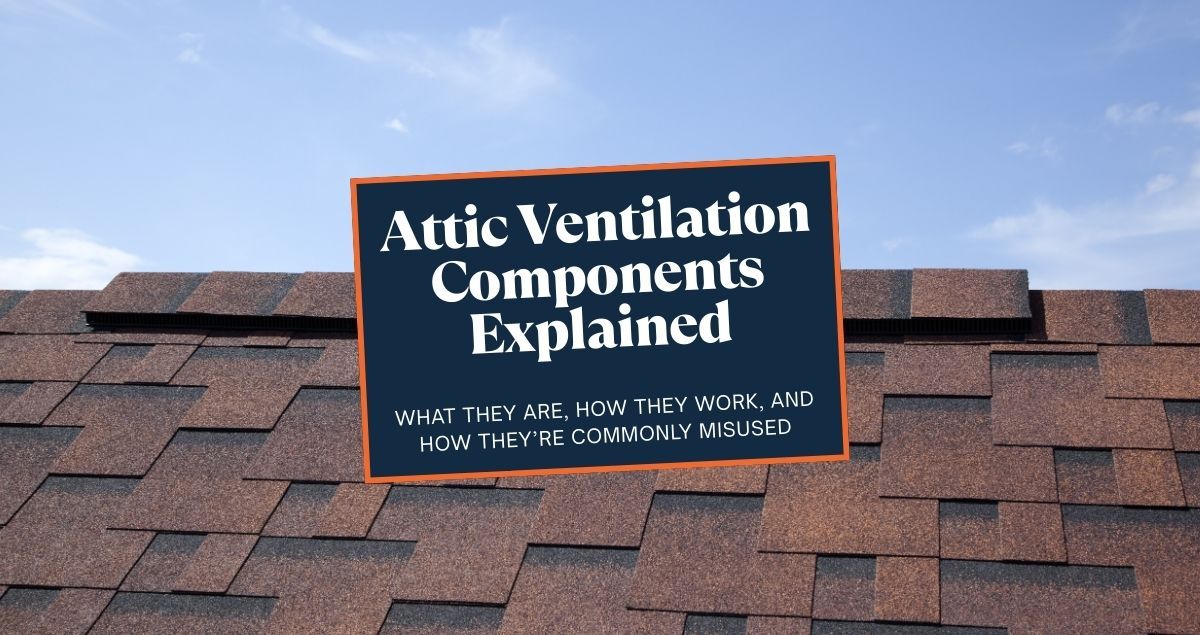

Once homeowners understand how attic ventilation is supposed to work, the next question is obvious.
TLDR: Attic ventilation systems need both intake and exhaust components working in balance. Soffits, ridges, and fans each serve specific purposes, and mistakes in their combination are among the most common roofing problems. Understanding these components helps you evaluate contractor proposals.
What are all these vents, and why do so many homes still have problems?
This article breaks down the most common attic ventilation components found on Colorado homes, what each one is designed to do, and how improper use often makes ventilation worse instead of better.
Ridge Vent
Ridge vent is an exhaust product installed along the highest point of the roof.
When used correctly, ridge vent allows warm, moist air to exit evenly across the roofline. However, ridge vent only works when it is installed at the same elevation and paired with adequate intake.
A common mistake is installing ridge vent on multiple ridges at different heights. When this happens, the highest ridge can pull air from lower ridge vents instead of from intake, effectively turning those lower ridge vents into unintended intake points.
Ridge vent is not a universal solution, and installing it everywhere a ridge exists often creates more problems than it solves.
Gable Vents
Gable vents are older ventilation components installed in the side walls of homes.
In modern roofing systems, gable vents are largely ineffective. They are not low enough to function as proper intake, and they do not provide sufficient net free air to function as effective exhaust.
In many cases, gable vents are intentionally blocked from the attic side as part of correcting attic ventilation. This is something we commonly do when redesigning a ventilation system. From the exterior, the vent still appears present, but it no longer contributes to the attic ventilation system.
Soffit Vents
Soffit vents are the preferred method of attic intake when they can be installed and maintained correctly.
Because soffits are located at the lowest point of the roofline, they allow fresh air to enter low and move upward through the attic toward exhaust. When soffit venting is properly designed, evenly distributed, and kept unblocked, it is typically the most effective and reliable source of intake air.
The problem is not that soffit vents are ineffective. It is that many homes do not have enough soffit venting, or the soffits that exist are blocked by insulation, paint, debris, or poor installation. In those cases, intake is restricted and the entire ventilation system underperforms.
When soffit vents are used, they must be:
- Adequate in quantity.
- Unblocked.
- Connected to a clear airflow path leading to exhaust.
Turtle Vents
Turtle vents are static exhaust vents installed on roof slopes.
They can work when installed correctly and when there is enough roof area at the highest point to support the required number of vents. However, many roofs do not have enough continuous high ridge or peak area to allow turtle vents to be installed correctly.
As a result, turtle vents are often placed in various locations across the roof at different heights. At best, this short-circuits the ventilation system. At worst, some of these vents begin functioning as intake, pulling moisture into the attic instead of exhausting air.
In the Colorado market, it is also not uncommon to see turtle vents incorrectly installed along the lower half of the roof and used as intake. This is an absolute no-no. Turtle vents are exhaust components and should never be used as intake.
This is one of the most common examples of ventilation that technically exists but functionally fails.
Power Vents
Power vents use mechanical assistance to move air.
They can be solar or electrically powered and do have specific applications where they make sense. However, motors wear out over time, and power vents should never be mixed with other exhaust types.
When improperly designed, power vents can pull conditioned air from the home rather than ventilating the attic, increasing energy loss and moisture problems.
Whirlybirds
Whirlybirds are highly effective exhaust vents with high net free air ratings.
They move a large volume of air and perform well in many conditions. However, like all exhaust systems, they still require a properly designed and balanced intake system to function correctly.
Aesthetic concerns are the most common objection to whirlybirds, not performance.
Low-Profile, High-Net-Free-Air Exhaust Options
Low-profile, high-net-free-air-rating vents, such as B135 vents, provide substantial exhaust capacity in a compact form.
These vents are an excellent option when ridge vent or turtle vents are not feasible, including on hip roofs where the peak ridge is short and does not allow enough space for traditional exhaust components.
Off-Ridge Intake and Exhaust Solutions
Products such as Lomanco Deck Air and O-Hagin Low Profile vents are commonly used when soffit venting is limited, blocked, or impractical.
These products are installed low on the roof and are more commonly used as intake in systems where soffit intake is not possible. In some configurations, they can also be used as exhaust, depending on placement and overall system design.
As with all ventilation components, their effectiveness depends entirely on how they are integrated into the full system.
One System, One Strategy
A properly designed attic ventilation system follows a few core rules:
- One intake type.
- One exhaust type.
- Exhaust should never exceed intake. If a system is unbalanced, intake should exceed exhaust, not the other way around.
- All intake should be located at the same height or level.
- All exhaust should be located at the same height or level.
Mixing exhaust types or placing vents at different elevations causes short-circuiting and airflow reversal, which is one of the fastest ways to make attic ventilation worse.
What Comes Next
Now that the components are understood, the next step is understanding what happens when ventilation fails.
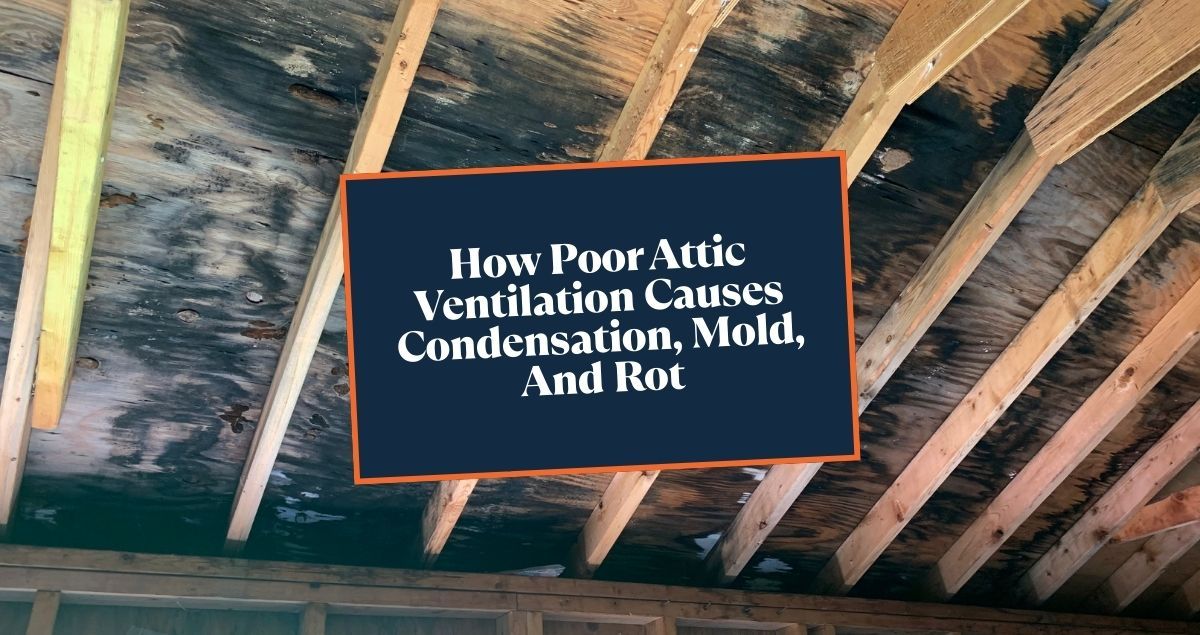
Next in this series: How Poor Attic Ventilation Causes Condensation, Mold, and Rot