




Most attic ventilation problems are not caused by neglect. They’re caused by well-intended but poorly designed “fixes.”
TLDR: Common mistakes include blocking intake vents, using wrong vent types, and creating imbalanced systems. These errors sometimes make ventilation worse than it was before. Hiring contractors who understand ventilation principles prevents costly errors.
In Colorado, many homes technically have vents, yet still suffer from condensation, ice dams, premature roof failure, or comfort issues. That’s because attic ventilation is often installed without a plan, without understanding airflow, or without verifying how the attic actually functions.
This article covers the most common attic ventilation mistakes roofers make, and why those mistakes often worsen conditions instead of improving them.
Mistake 1: Adding Exhaust Without Confirming Intake
This is the single most common mistake.
Many contractors add ridge vent, turtle vents, or power vents without verifying whether adequate intake exists. Exhaust cannot function properly unless there is sufficient intake air to replace what is being removed.
When exhaust exceeds intake, the system becomes unbalanced. Air is then pulled from unintended sources, such as:
- Other exhaust vents.
- Gable vents.
- The living space below.
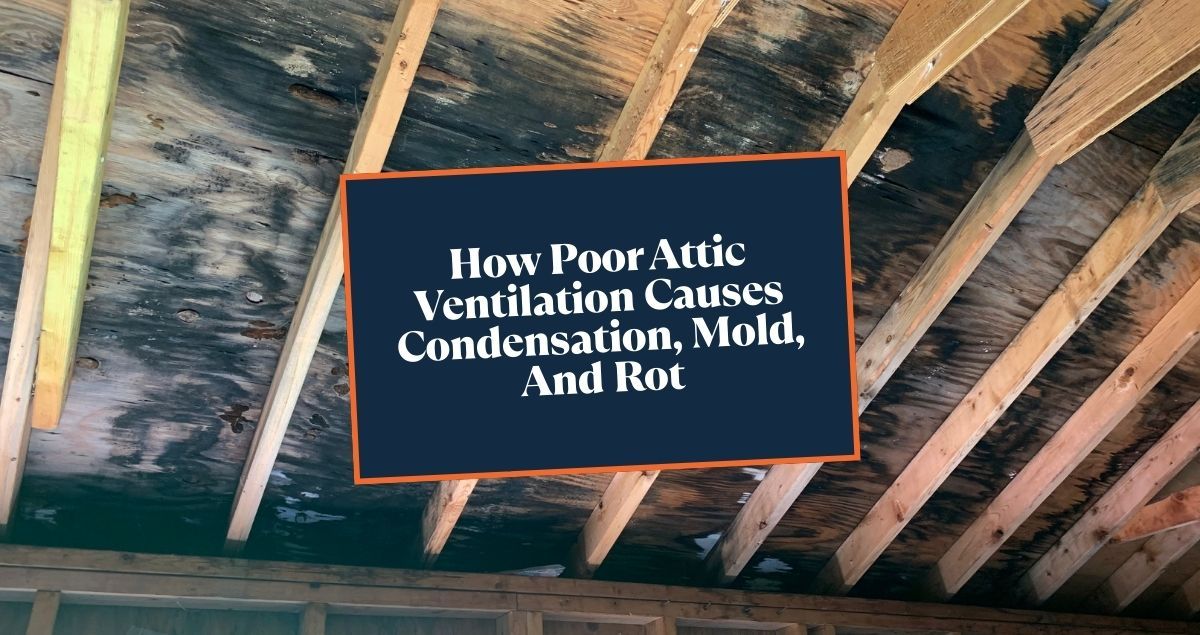
This defeats the purpose of ventilation and can actually increase moisture and heat retention in the attic.
If a ventilation system is unbalanced, the correction is almost always more intake, not more exhaust.
Mistake 2: Mixing Multiple Exhaust Types
Another common issue is combining different exhaust components on the same attic.
Examples include:
- Ridge vent combined with turtle vents.
- Power vents combined with ridge vent.
- Whirlybirds mixed with static exhaust vents.
This creates short-circuiting, where exhaust vents pull air from each other instead of from intake points. Air takes the path of least resistance, and that path is rarely the soffit when multiple exhaust elevations exist.
A properly designed system uses:
- One exhaust type.
- One intake type.
- All exhaust at the same height.
- All intake at the same height.
Mixing exhaust components almost always reduces effectiveness.
Mistake 3: Installing Ridge Vent on Every Ridge Line
Ridge vent only works correctly when it is installed at the highest continuous ridge line of the attic space being ventilated.
When ridge vent is installed on multiple ridges at different heights:
- Lower ridge vents can act as intake.
- Upper ridge vents can pull air from lower ridges.
- The attic never fully flushes heat and moisture.
This mistake is especially common on complex rooflines and mountain-style homes.
Mistake 4: Using Turtle Vents Incorrectly
Turtle vents, also called box vents, can be effective exhaust vents when used correctly. However, they are often misused.
Common issues include:
- Not enough turtle vents to meet exhaust requirements.
- Turtle vents installed at varying heights.
- Turtle vents installed on the lower half of the roof acting as intake.
In the Colorado market, it’s not uncommon to see turtle vents incorrectly used as intake vents. This is a major problem. Turtle vents are exhaust components and should never be used as intake.
When misused, turtle vents can draw moisture into the attic instead of removing it.
Mistake 5: Ignoring Blocked or Covered Intake
Soffit vents are the preferred method of intake when they are available and unobstructed. Unfortunately, many homes have soffit vents that are:
- Covered by insulation.
- Blocked by framing.
- Painted shut.
- Never actually connected to the attic space.
Adding exhaust without confirming that soffit vents are open and unobstructed does not improve airflow.
A proper installation often requires verifying intake from inside the attic or temporarily removing sections of decking during roof replacement to confirm airflow paths.
Mistake 6: Treating Gable Vents as Functional Ventilation
Gable vents are largely ineffective in modern attic ventilation design.
They are typically:
- Too high to function as intake.
- Too low to function as exhaust.
- Insufficient in Net Free Area.
In many properly corrected systems, gable vents are intentionally blocked from the inside to prevent short-circuiting and to allow soffit-to-ridge airflow to function as designed. From the exterior, nothing changes visually.
Mistake 7: Failing to Account for Multiple Attics
Many homes do not have one large attic. They have multiple attic spaces separated by framing, fire blocks, or roof geometry.
Each attic space must be ventilated independently.
Calculating ventilation for the entire roof without identifying separate attic spaces leads to under-ventilated areas, which are often where condensation, mold, or decking deterioration occurs.
Mistake 8: Skipping Verification During Installation
Ventilation design should happen in two phases:
- Initial design based on plans and visible features.
- Verification during installation.
Roof replacement is often the only time contractors can:
- Identify hidden attic separations.
- Confirm insulation depth and obstructions.
- Install baffles to maintain airflow paths.
Skipping this verification step turns a calculated system into an assumption.
Why These Mistakes Persist
Many of these issues are not malicious. They happen because:
- Ventilation is treated as a checkbox.
- Crews are trained to install products, not design systems.
- Speed is prioritized over evaluation.
- Storm-driven work encourages volume over precision.
The result is a roof that looks new but performs poorly.
What Homeowners Should Listen For
A contractor who understands attic ventilation should be able to explain:
- How many attic spaces your home has.
- Where intake air enters.
- Where exhaust air exits.
- Why specific products were chosen.
- How balance is achieved.
If ventilation is described only as “adding ridge vent,” that is usually a red flag.
Final Thoughts
Attic ventilation problems are rarely caused by a lack of vents. They are caused by poor design.
When intake and exhaust are balanced, placed correctly, and verified during installation, attic ventilation supports roof longevity, energy performance, and moisture control.
The absence of problems is usually the best indicator that ventilation is working.