

Next Up: Why Home Insurance in Colorado Is Changing
Related: Defensible Space vs Home Hardening
TLDR: Home hardening is the practice of reducing your home's vulnerability to wildfire, hail, and wind through smarter materials, construction details, and maintenance habits. It's not one upgrade or one product. It's a way of making better decisions over time, especially when you're already spending money on the exterior of your home. This guide explains what it actually means, why it matters in Colorado right now, and how to approach it without pressure or panic.
Most Colorado homeowners have never heard the phrase "home hardening" until something forces them to. A nearby fire. A renewal notice with a big premium increase. An insurance agent who mentions it in passing but doesn't explain what it means.
That's not a great way to learn about it. It makes the concept feel urgent and vague at the same time.
Here's a calmer version.
What is home hardening?
Home hardening is the practice of reducing how vulnerable your home is to damage from wildfire, hail, and wind. Not eliminating risk. Reducing it.
It covers materials, construction details, maintenance habits, and landscaping. It's not one upgrade. It's a way of thinking about your home that considers how it would behave when something bad happens.
A hardened home isn't fireproof. It isn't hailproof. What it is, is more likely to come through a storm or a wildfire with less damage than a home that was built or maintained without those threats in mind.
Why does Colorado face unique risks compared to other states?
Colorado sits in an unusual spot when it comes to home risk. The Front Range gets some of the most frequent and severe hail in the country. The foothills and mountain communities sit inside wildland-urban interface zones, where residential neighborhoods meet dry forests and open grasslands.
And increasingly, those two risk profiles are overlapping. After the Marshall Fire burned through Boulder County in December 2021, destroying more than a thousand homes on a day with no snow on the ground and winds gusting over 100 miles per hour, a lot of Colorado homeowners started rethinking what they assumed about where they lived.
The insurance industry rethought it too. Rates went up. Underwriting tightened. Some carriers pulled back from high-risk areas entirely. Homeowners who had never filed a claim found themselves paying significantly more, or having trouble renewing coverage at all.
What does a hardened home actually look like?
When people hear "hardening," they sometimes imagine a dramatic renovation. The reality is usually more measured.
Some of the most important steps are relatively modest upgrades, like replacing standard roof vents with ember-resistant versions, or pulling combustible mulch away from the foundation and replacing it with gravel or stone in that first five-foot zone around the house.
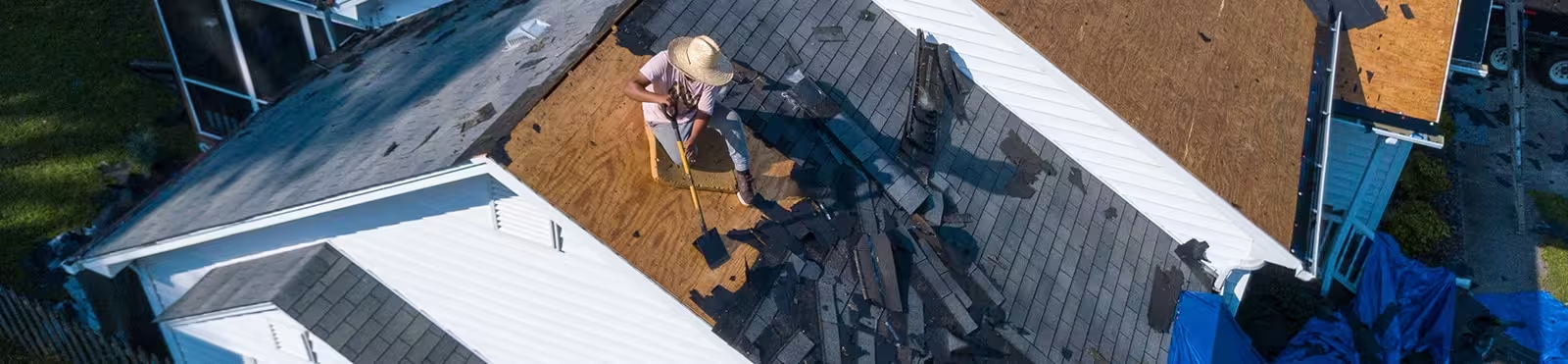
Other steps are bigger decisions, made when something is already being replaced. If your roof needs to come off, that's the time to talk about Class A fire-rated assemblies or Class 4 impact-resistant materials. Some roofing systems are engineered to address both fire and hail at the same time, including stone-coated steel systems that carry Class A fire ratings and pass very severe hail testing.
→ Stone-Coated Steel Roofing in Colorado: A Long-Term Solution for Hail, Snow, and Energy Efficiency
The goal isn't to do everything at once. It's to make smarter decisions over time, especially when money is already being spent on the exterior of the home.
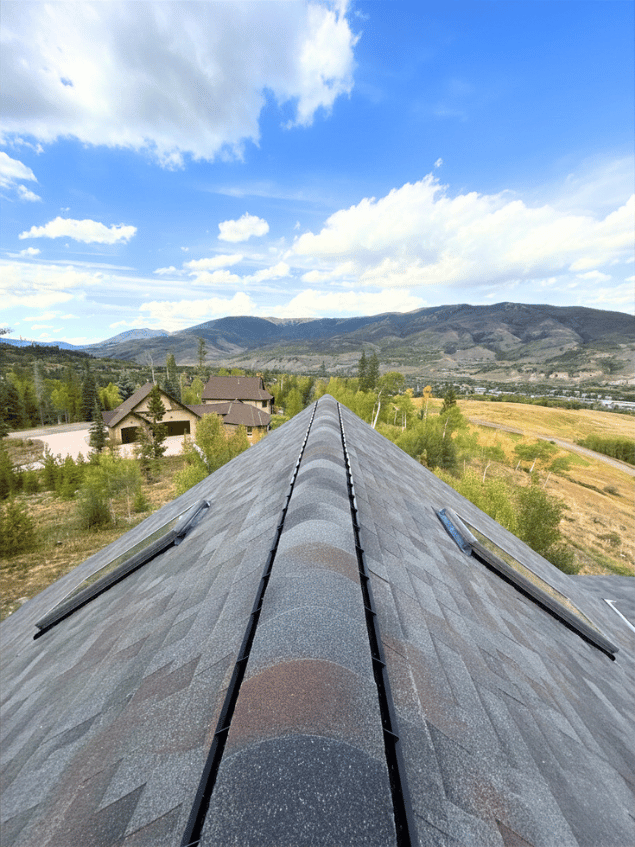
In our work across Summit County, Eagle County, Pitkin County, and Grand County, the roofs we're replacing more often than not have outdated ventilation systems with no ember-resistant covers or filters on any of the components. When a roof is already coming off, that's the moment to address it. Updating the attic ventilation setup with ember-resistant covers is one of the most meaningful home hardening improvements you can make to a mountain home, and it's a lot easier to do right when the roof is already in the plan.
What is the difference between roofing materials and roofing systems?
One distinction worth understanding early is the difference between materials and systems.
A single shingle has a fire rating. But a roof assembly, the combination of decking, underlayment, and the roofing material itself, has a different and often more meaningful rating. What a shingle can do on its own is not always what the full assembly can do.
The same is true for siding. A material might resist heat. But if it's installed over gaps or without proper flashing, embers can still find their way into wall cavities. This is why home hardening is more of a systems conversation than a product conversation. If you want guidance on which roofing system makes sense for your home's location and structure, the Roof Type Guide walks through how those factors interact in Colorado.
→ What Roof Type Is Best for My Home?
Why does home hardening matter more now than it used to?
Colorado homeowners are carrying more financial risk than they used to. Deductibles have gone up, especially for hail and wind events. In some areas, hail-specific deductibles now run two to three percent of the home's insured value, which on a $600,000 home is $12,000 to $18,000 out of pocket before insurance covers anything.
That changes the math on moderate damage. It's not always worth filing a claim for a storm that causes $15,000 in damage when your deductible is $12,000 and you know that filing will affect your premiums or renewability.
Homes that are built or upgraded to reduce the likelihood and severity of damage give their owners more options. They file fewer claims. They carry less risk of non-renewal. None of that is guaranteed. But it's the direction things are moving, and home hardening is a reasonable response to that direction.
Where should I start?
This series walks through each piece of the home hardening picture. We cover why insurance is changing, what higher deductibles mean for how you make decisions, how fire ratings actually work, where embers enter homes, and how hail resistance fits into a longer-term durability strategy.
Start with whatever is most relevant to where you are. If you're in a wildfire zone, the fire rating and ember intrusion articles will be most immediately useful. If you're on the Front Range and hail is your primary concern, the hail resistance and deductibles pieces are a better starting point.
If you want a quick, personalized read on where your home currently stands across all of these risk areas, the Home Hardening Quiz takes about two minutes and gives you a score based on your specific situation.